Detecting Surface Defects on Sensitive Sensor Modules in EV Manufacturing
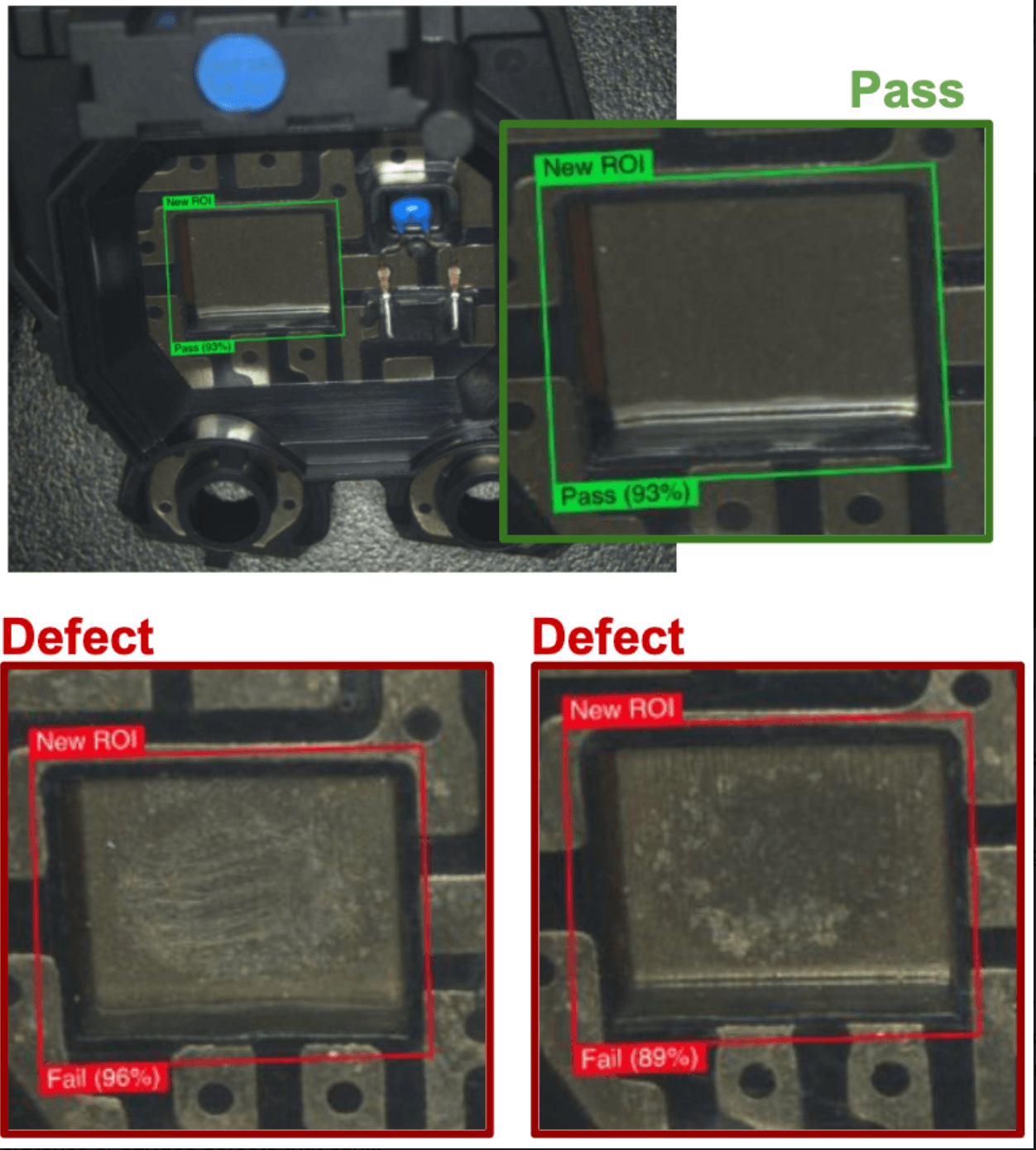
Modern EVs and electrified platforms rely on a dense network of sensors-pressure, temperature, acceleration, current, and position modules. These units must maintain pristine surface integrity to ensure proper sealing, electrical grounding, and alignment.
The Challenge: Microscopic Defects, Massive Consequences
But manufacturing them is unforgiving:
- Microscopic scratches or blemishes alter coating uniformity, introducing variation in sensor calibration.
- Grey-on-black housings and semi-reflective polymers make contrast low, defeating standard AOI.
- Oil films, static dust, and curved geometries add unpredictable reflections.
Traditional inspection systems-rule-based AOI or even early machine-learning models-struggle to generalize. They need hundreds of images, careful lighting control, and still miss faint low-contrast lines that affect sensor reliability.
In EV supply chains where throughput and yield drive cost, this meant rework loops, late defect discovery, and inconsistent quality data across lines.
Why the Problem Is Hard
Low Optical Contrast
Grey coatings on dark housings provide almost no brightness difference; threshold-based detection fails.
Surface Reflectivity
Shiny or semi-matte plastics scatter light unevenly, creating false positives.
Tiny Defect Scale
Scratches can be < 0.1 mm, smaller than a single pixel in older AOI setups.
Data Scarcity
Sensor programs produce many variants but few examples per variant-training a deep model from scratch isn't feasible.
The Overview AI Solution
Using the OV20i Vision System, Overview AI engineers deployed a classifier recipe trained with just 8 good and 8 defective samples-a total of 16 images.
Key Design Principles
Edge Training
All learning occurs locally on the OV20i's NVIDIA Orin NX GPU-no cloud uploads, no latency.
Smart Illumination
Diffuse and coaxial lighting combinations reveal texture differences invisible to the naked eye.
Adaptive Model Design
The classifier learns feature patterns (texture, gloss gradients, edge discontinuities) rather than fixed brightness values, allowing reliable detection across varied lighting.
Fast Iteration
Engineers can relabel or add images directly in a browser interface; each training cycle takes < 30 minutes.
Within a single shift, the system achieved state-of-the-art accuracy identifying both microscopic blemishes and larger scratches-even on low-contrast grey-on-black surfaces where conventional systems failed.
Results and Impact
Tiny-Data Efficiency
Production-ready model trained from 16 images.
Lighting Robustness
Stable detection under daylight, LED, and overhead fluorescents.
Consistent Yield
Defects caught inline before assembly, preventing downstream module rejects.
Scalable Deployment
Recipe transferable to other sensor or connector variants with minor retraining.
For EV suppliers, that means fewer false rejects, faster root-cause feedback, and traceable quality records suitable for PPAP and IATF 16949 audits.
FAQs
Why are scratches so critical on EV sensor modules?
Even microscopic surface damage can alter sealing pressure or interfere with optical/electromagnetic sensitivity, leading to drift or early failure.
How little data can Overview AI train on?
Classifier recipes commonly start from 5–10 images per class. Transfer learning and data augmentation close the gap to large-dataset performance.
Does the system need controlled lighting?
No. The OV-series uses adaptive lighting and exposure control, and the AI learns reflectivity patterns so models remain stable under realistic shop-floor conditions.
How fast can it be deployed?
Typical proof-of-concept to validated model in under 2 hours, including capture, labeling, and training.
Is this compatible with existing PLC or MES?
Yes. EtherNet/IP and PROFINET connectivity allow direct pass/fail output and data logging for traceability.
Related Reading
Anomaly Detection: Inspecting With Only Good Samples
How unsupervised anomaly detection finds defects you have never photographed, why it suits textured and low volume parts, and the cases where a trained defect model is still the better answer.

Backtesting an Inspection: Proving It Works Before It Ships
How to validate a vision recipe offline against known parts, build a test set that does not flatter you, and run a repeatability study on an AI inspection before it gates production.
Escape vs Overkill: Measuring a Vision System Honestly
Accuracy is the wrong number for an inspection station. Escapes, overkill, yield and gauge R&R are what quality engineers actually need, and how to measure them before a system goes live.
Ready to Transform Your Sensor Quality Workflow?
Explore Overview AI's OV20i to see how small-data AI can detect microscopic defects on low-contrast surfaces.
See how Overview AI inspects EV sensor surface defects
Send us a photo of your part or defect and a vision engineer will tell you whether Overview can catch it, with most systems deployed on the line in days.
Related Articles
3 Quality Inspection Challenges in Battery Gigafactories (and Fixes)
The three quality inspection challenges gigafactories face and how AI vision addresses them.
Read More →AI Inspection for Gigafactory Battery Cell Production
How AI vision inspects battery cells at gigafactory scale to prevent escapes and recalls.
Read More →Ghost Defects in Battery Welds: How Edge AI Makes the Invisible Visible
Detecting micron-scale weld misalignments on reflective battery caps with edge AI.
Read More →