AI Vision for Pharma & Medical Devices
Pharmaceutical and medical device vision inspection is the automated visual check of tablets, packaging, vials and finished devices for defects that affect patient safety, product quality and regulatory compliance. Overview's smart cameras detect micron-scale defects, verify assembly and labelling, and retain a per-part image record for QA.
Pharmaceutical & Medical Solutions
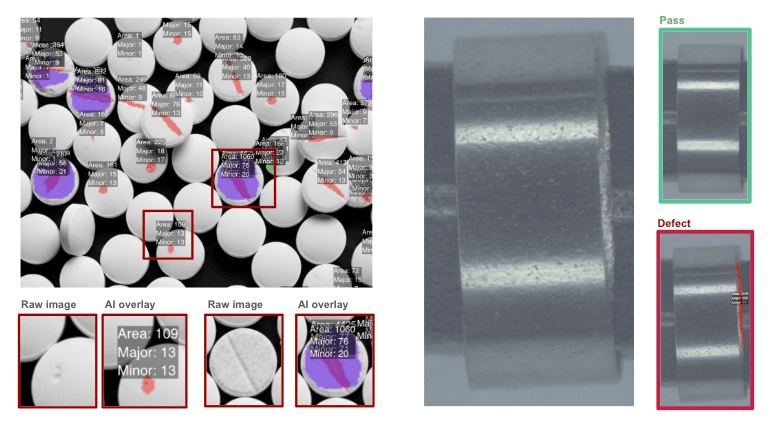
Pharma and MedTech lines produce defects that are small, inconsistent in appearance, and rare. Rule-based vision handles a fixed defect on a fixed background. It fails when the same scratch appears at a different angle on a reflective surface, or when a contaminant shares a colour palette with the part underneath it. Deep learning vision learns the defect from examples instead of from thresholds, which is why it holds up on tablet surfaces, glass vials and 1 mm surgical components.
Overview's GPU-powered cameras run the model on the camera. Inspections are trained in a browser, typically from a few dozen images, and every part leaves an image and a result that QA can retrieve. Systems run today at manufacturers including Thermo Fisher Scientific, Stryker, Avalign, Valtronic and Salutas Pharma.
Defects AI Vision Detects in Pharma & Medical Production
The defects below are the ones that reach Overview most often, grouped by product form.
Tablets and capsules
Capping and lamination
What it is: The tablet splits horizontally, or separates into distinct layers.
Why it matters: A laminated tablet dissolves unpredictably, so dose delivery is no longer the dose on the label.
Picking and sticking
What it is: Material pulls away from the tablet face onto the punch, leaving pits and damaging embossed logos.
Why it matters: A damaged imprint breaks tablet identification, which is a patient safety control, not a cosmetic one.
Chipping and edge damage
What it is: Edges break away during compression, ejection or transfer.
Why it matters: Chips shed dust into the pack and shift the delivered dose below specification.
Black specks and surface contamination
What it is: Dark or coloured particles embedded in or sitting on the tablet surface.
Why it matters: Foreign matter in a finished dosage form is a recall trigger and a reportable deviation.
Blister packs and final packaging
Seal defects
What it is: Incomplete, wrinkled or channelled seals on a blister cavity or pouch.
Why it matters: A compromised seal ends barrier protection, so the assigned shelf life no longer applies.
Missing or wrong contents
What it is: An empty cavity, a broken tablet, or a unit that does not match the rest of the pack.
Why it matters: Mixed product in one pack is a cross-contamination event and the highest-severity packaging defect.
Label presence and alignment
What it is: A label that is absent, skewed, lifted at a corner, or applied to the wrong panel.
Why it matters: Labelling errors are among the most common causes of pharmaceutical recalls.
Lot code and expiry legibility
What it is: Printed lot, batch and expiry text that is faint, smeared, doubled or truncated.
Why it matters: An unreadable lot code removes the ability to trace and recall that batch.
Vials, ampoules and syringes
Glass body defects
What it is: Cracks, scratches, airlines, bubbles and inclusions in the container wall.
Why it matters: A cracked container loses sterility, and glass fragments can enter the drug product.
Visible particulate matter
What it is: Mobile, undissolved particles in an injectable solution, distinct from air bubbles.
Why it matters: Injectable products must be essentially free of visible particulates, and bubbles are the main cause of false rejects.
Stopper and seal seating
What it is: A stopper that sits high, tilted or partially inserted, or a crimp cap that is not fully formed.
Why it matters: Container closure integrity depends on seating, and a raised stopper fails it without looking obviously wrong.
Fill level
What it is: A meniscus above or below the accepted fill window.
Why it matters: Underfill delivers a short dose and overfill signals an upstream pump or timing fault.
Medical devices and components
Micro-scratches on small parts
What it is: Fine surface scratches and tool marks on reflective components, often below what an operator sees without a microscope.
Why it matters: A scratch on an implant or a fluid path becomes a crevice for biofilm and a crack initiation site.
Foreign material and fibres
What it is: Hair, lint, swarf and packaging fibre on a cleaned part, frequently in a colour close to the part itself.
Why it matters: Particulate on a device surface is a cleanliness failure and, for sterile devices, a bioburden risk.
Presence, absence and seating
What it is: A missing component, or a component present but not fully seated, in an assembly or a kit.
Why it matters: An incomplete sterile kit is discovered in theatre, which is the most expensive place to find it.
UDI marking legibility
What it is: A direct part mark or label carrier that is incomplete, low contrast or unreadable.
Why it matters: Unique device identification is a regulatory requirement, and an unreadable carrier breaks traceability at the point of use.
The Regulations These Inspections Sit Under
Inspection specifications in pharma and medical device manufacturing are written against published requirements. The primary sources below are the ones most often cited in the inspection plans we are asked to meet.
21 CFR Part 211: current good manufacturing practice for finished pharmaceuticals, including the requirement that packaging and labelling operations be inspected to prevent mix-ups (eCFR).
Visible particulates in injectables: FDA guidance sets the expectation that injectable products are essentially free of visible particulates and describes the inspection programme behind that claim (FDA guidance, which works alongside USP general chapter <790>).
EU GMP Annex 1: the manufacture of sterile medicinal products, which covers container closure integrity and 100% inspection of filled units (European Commission).
21 CFR Part 830: unique device identification, which requires a device to carry a UDI that is readable in both plain text and machine-readable form (eCFR).
21 CFR Part 11: electronic records and electronic signatures, which governs how inspection results and retained images are stored, attributed and audited (eCFR).
Overview supplies the inspection record: a retained image, a result and the model decision for every part. Validation of that record inside your quality system remains your process, and we support it with the exported evidence rather than replacing it.
What These Inspections Look Like in Production
Four deployments from the Overview defect library, with the setup and the measured result.
Tablet surface defects
Problem: Picking, lamination and chipping on the same line, each inconsistent in size, appearance and location.
Setup: An OV20i running a segmentation recipe, trained on 8 images in under an hour.
Result: 100% accuracy across 45 test samples, with per-defect metadata the customer used to drive their own reject logic. Read the full case.
Micro-scratches on 1 mm surgical rings
Problem: Manual inspection took 10 seconds per ring under a microscope and needed a month of operator training. Industrial cameras had already failed on resolution and glare.
Setup: An OV80i with a 150 mm lens and on-axis lighting, trained on 10 defective samples in 2.5 hours.
Result: 100% accuracy on 40 validation samples with zero misses and zero overkill. In production the system inspects 20 rings per second and lifted throughput from 10,000 to 37,672 parts per day. Read the full case.
Contaminants on medical electronics
Problem: Fine contaminants such as loose hair strands, in colours overlapping the part beneath them.
Setup: A segmentation recipe locating each contaminant, with length and area thresholds applied downstream to hold overkill down.
Result: The same camera and program were later extended to check label placement, so one station covers both inspections. Read the full case.
Component seating on medical tubing
Problem: Verifying not just that a keeper was present on a tube, but that it was correctly seated.
Setup: An OV10i running classification on a single region of interest, trained on 7 reference images in under 5 minutes.
Result: 100% accuracy at 100 ms per part, with no external lighting. Read the full case.
Pharma & Medical Applications
Drug-Delivery Device Inspection
Presence/absence, position/orientation, and label verification
Face Mask Quality Control
Embedded fibers, stains, strap presence, dimensional checks
Final Packaging Inspection
Seal verification, label presence/alignment, carton completeness
Medical Device Part Inspection
Surface defects, scratches, dents, flash on small medical parts
Transdermal Patch Inspection
Coating coverage, edge integrity, print/lot verification
UDI Marking & Label Quality
Label presence/alignment and OCR legibility checks
Device Traceability Visual Checks
Visual confirmations for label, assembly state, lot prints
Package Integrity & Sterility
Pouch/blister seal defect detection
Pack Assembly & Kit Inspection
Kit completeness and orientation verification
Pack Aggregation & Palletization
End-of-line visual gates for carton state and labels
Vial & Ampoule Body Inspection
Detect cracks, scratches, bubbles, inclusions on glass
Particulate Matter Inspection
Identify particulates in vials while avoiding bubbles
Blister Pack Integrity & Contents
Seal openings, wrong/missing contents verification
Products for Pharma & Medical
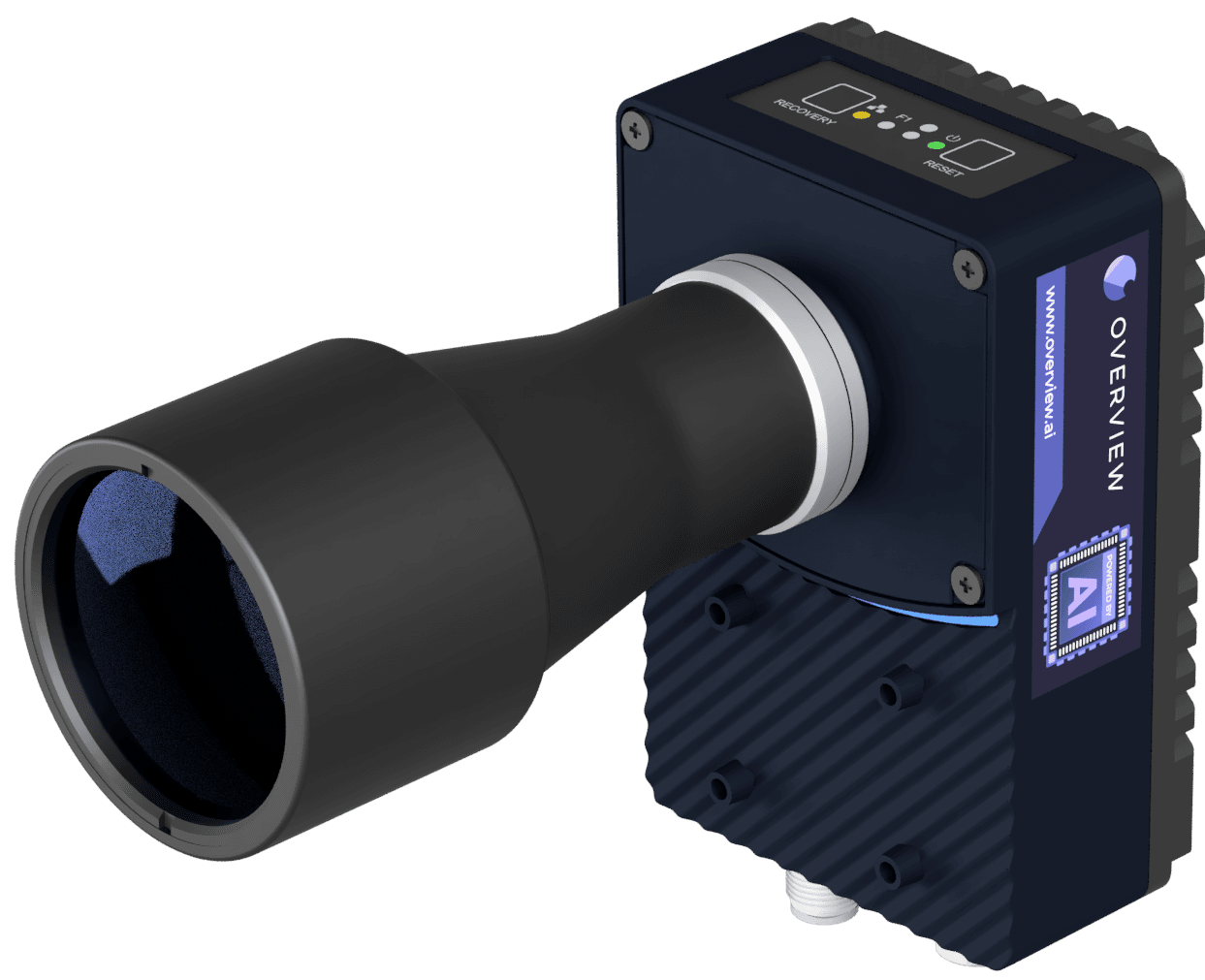
OV80i Vision System
Best for: micro-defects & precision measurement on small/reflective parts
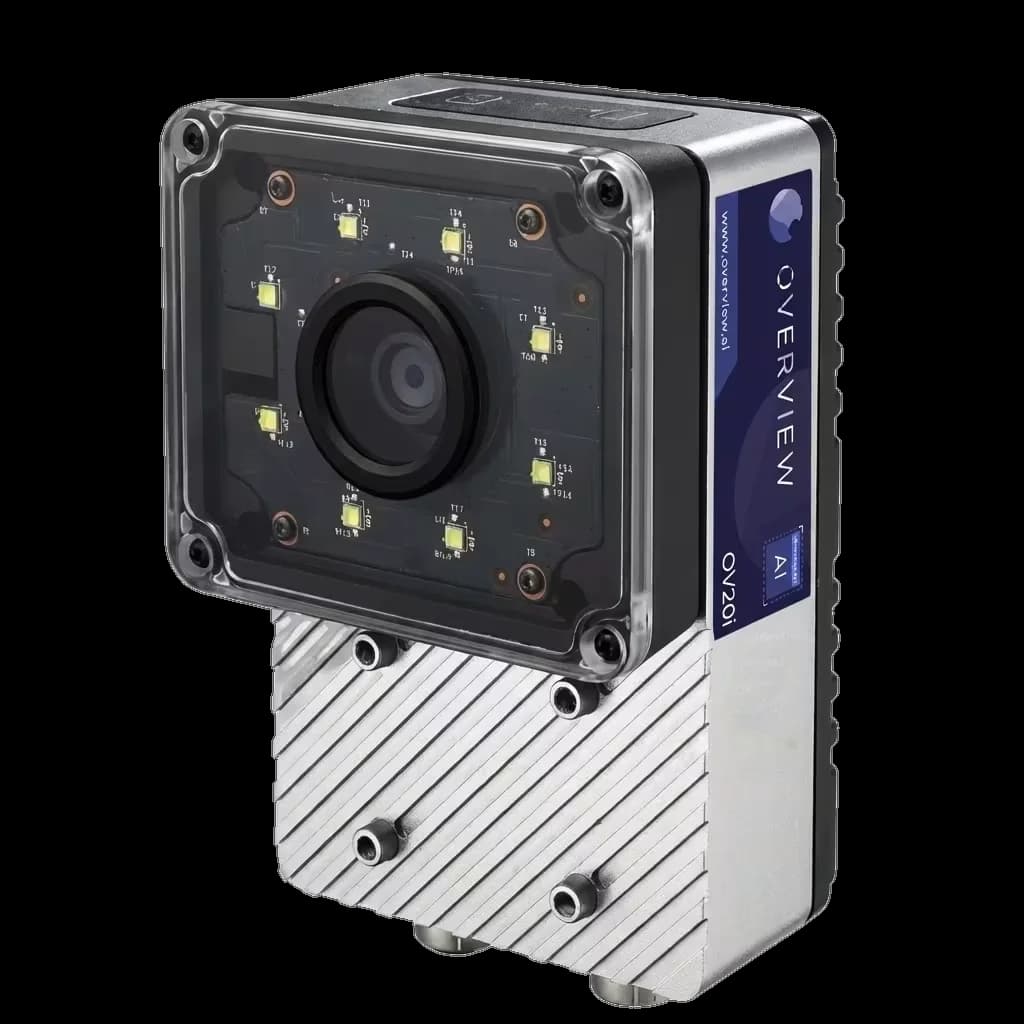
OV20i Smart Camera
Best for: compact all-in-one surface/assembly checks and mixed defects
OV10i Smart Camera
Best for: fast classification & presence/absence (labels applied, kit completeness)
Go Deeper
12 common tablet defects
Every tableting defect, what causes it, how to prevent it and how inspection catches it at line speed.
Defect library
Real deployments with the camera, lens, lighting, training set and measured result for each one.
OVX platform
Where inspections that outgrow a single smart camera run, including multi-camera and existing-camera lines.
Ready to Improve Your Pharma & Medical Quality Control?
See how Overview's AI vision can protect your patients and products