300+ Connector SKUs.Zero Real Defects Collected.
A high-mix connector manufacturer needed scratch and dent inspection across hundreds of SKUs. Damaging real parts to build a training set is destructive, slow, and expensive. The OV Auto-Defect Creator Studio synthesized the defects per SKU, on real reference images, with zero physical parts harmed.
The Problem
Hundreds of SKUs is the reality, not the exception.
A modern connector line runs hundreds of active SKUs through the same production cells: SFP cages, pin-matrix headers, multi-cavity housings, bracket assemblies, hex-pattern cages, four-row card cages. Each variant has its own geometry, its own surface, its own ways of failing.
Classical computer vision says: collect real defect samples per SKU, label them, train a model. That answer does not survive contact with reality. Real defect samples either do not exist yet (the SKU is new), or accumulate too slowly (most defects are too rare to gather in volume), or are too expensive to manufacture deliberately (production-grade housings cost real money to damage on purpose).
The studio swaps that bottleneck. Synthetic defects are authored on real reference images per SKU. The training data exists by the end of the shift. The training data covers every SKU on the line.
In The Studio
Prompt the defect. The SKU never gets damaged.
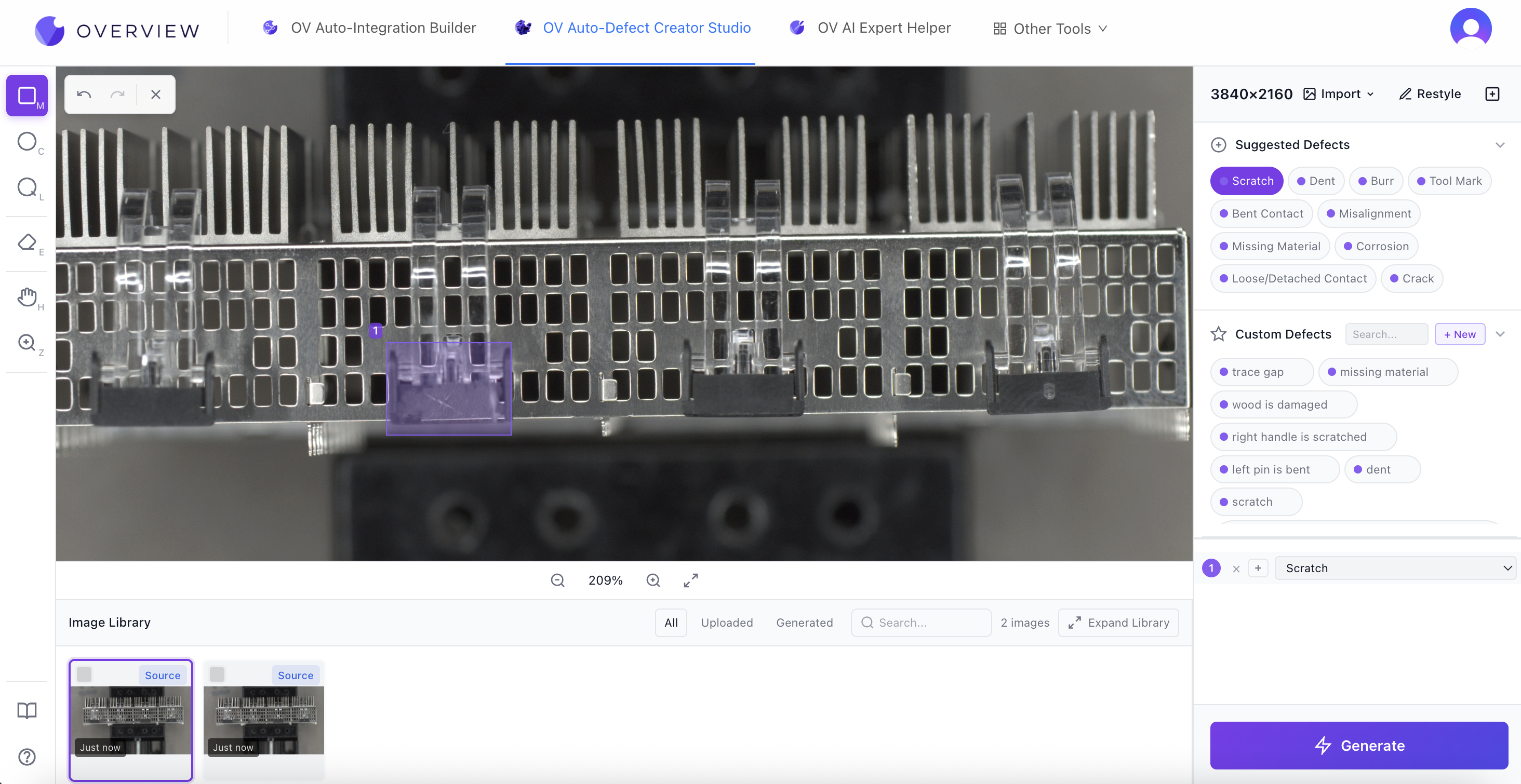
A reference image of the connector is loaded into the OV Auto-Defect Creator Studio. The operator selects the area where the defect should appear and picks Scratch from the AI-suggested defect classes. The studio handles the rest, rendering a photorealistic synthetic defect anchored to the real connector surface.
Scratch · Across SKUs
Same defect class, every connector variant.
A representative slice of the scratch dataset, generated across nine distinct connector SKUs. The synthetic defects respect the geometry and lighting of each real reference image. Every sample carries its pixel-level segmentation mask.
Dent · Across SKUs
Second defect class. Same studio, same workflow.
A representative slice of the dent dataset across ten more SKUs. Each one a different geometry, each one authored in seconds from the SKU's own reference image. No two connectors share a training assumption.
Why This Works
Capabilities on Display
Four properties of synthetic-data inspection that make high-SKU connector lines actually trainable.
No Real Parts Damaged
Generating real scratches and dents on production hardware to build a dataset is destructive, slow, and expensive. The studio damages zero physical parts and produces the same training value.
Per-SKU Coverage at Scale
Each connector SKU gets its own synthetic defect samples authored on its own reference image. No shared assumptions, no cross-contamination between SKU classes.
New SKUs Onboard in Hours
When the OEM specifies a new variant, defect samples for that SKU exist by the end of the same shift. No multi-week data collection effort holds up the changeover.
Production-Ready Output
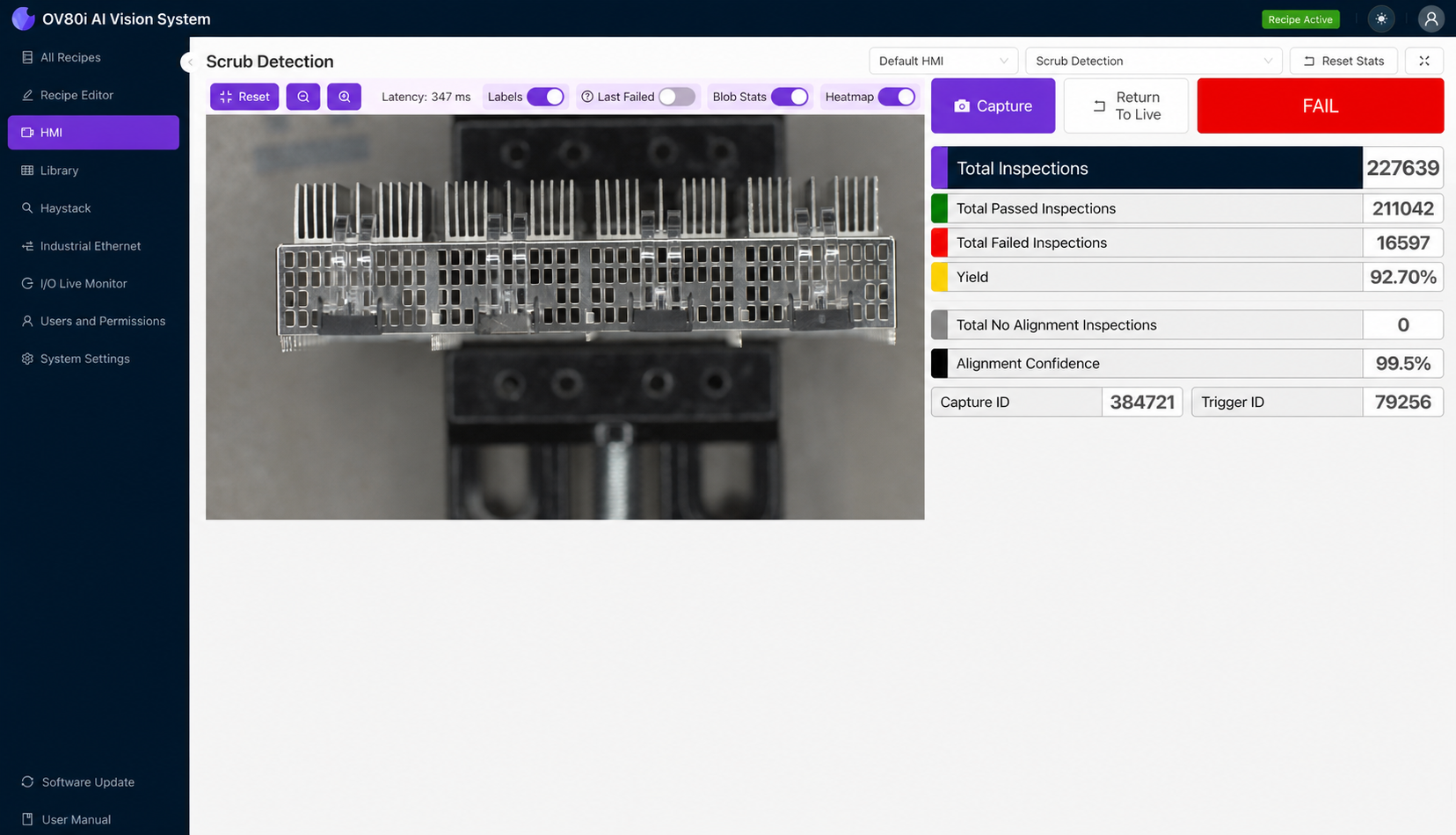
The trained recipe runs on the OV80i as Scrub Detection, with full HMI statistics: total inspections, pass/fail, yield percentage, and alignment confidence.
Live On The Line
Scrub Detection. 92.7% yield. Real connectors.
The trained recipe hot-swapped into the OV80i HMI as the Scrub Detection profile. The live screen shows the production line catching real defects across 227,639 inspections with 99.5% alignment confidence. The training data was synthetic. The defects it catches are real.
Explore More
Other Use Cases
Contaminant Verification
Food-safety contaminant detection on an oatmeal belt. Trained entirely on synthetic foreign-object defects, validated against real metal, plastic, and a sharp nail.
Wood Flooring Scratch Inspection
Synthetic scratch generation on engineered wood flooring, then Style Transfer across laminate and composite finishes.
Cover Every SKU on Your Line, Without Breaking a Single Part
Send us reference images of the SKUs you care about. We return synthetic defect samples per SKU, ready to train, ready to ship to your inspection station.