Contaminant VerificationTrained on Synthetic. Tested on Real.
A step-by-step walkthrough of how a cereal manufacturer deployed a food-safety contaminant verification model on a pre-pack oatmeal belt in 15 minutes. The training set contained zero real foreign-object samples. Every defect was authored inside the OV Auto-Defect Creator Studio. The deployed model catches real metal, real plastic, and real nails on the first frame.
Full Workflow
11-Step Walkthrough
Follow the full deployment from the first reference capture to the moment a real nail is dropped on the belt and caught on the first frame.
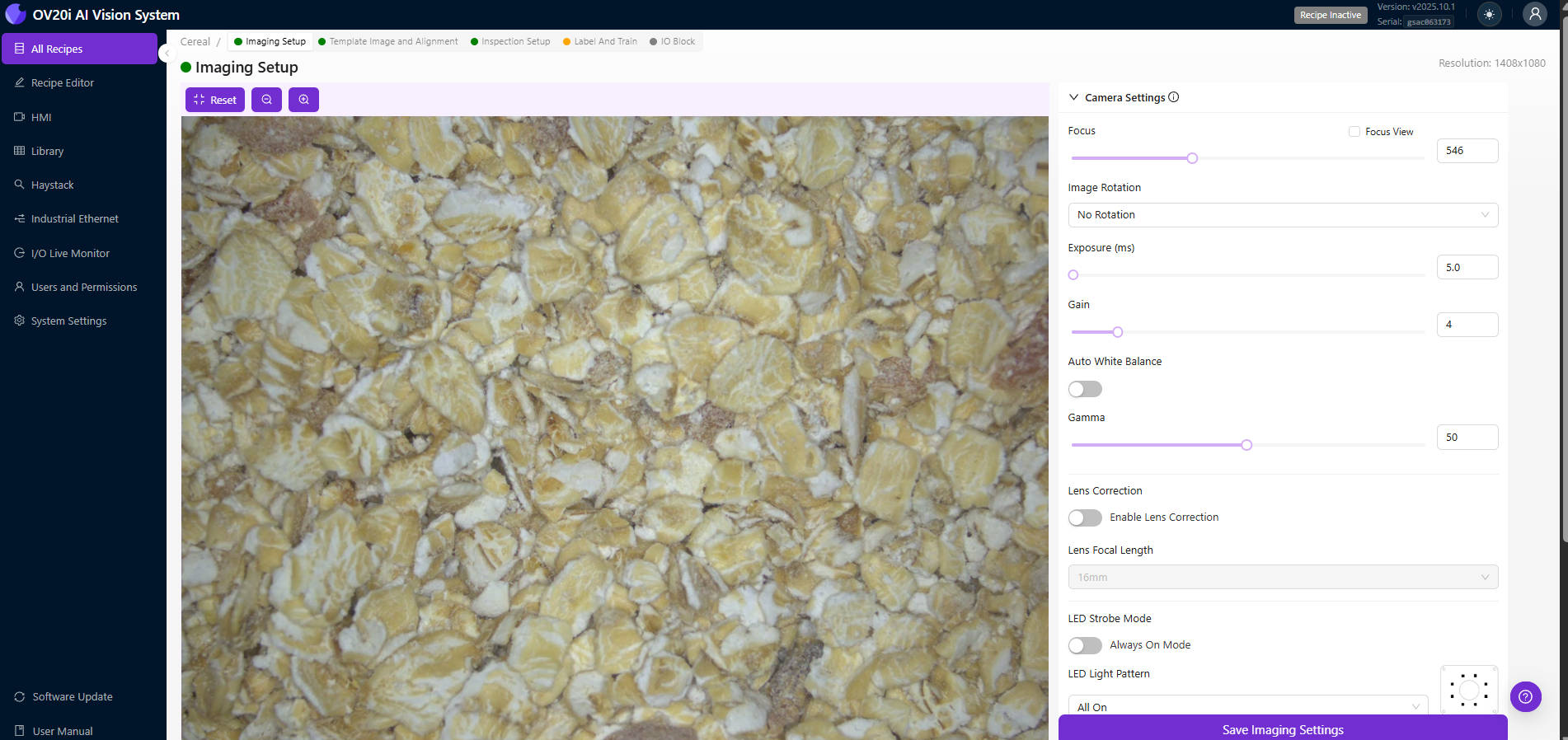
Capture the Good Pile
The OV80i is mounted above the pre-pack oatmeal belt with imaging settings tuned for the pile texture. The operator scrambles the pile and captures 13 clean reference images at production belt speed and lighting. The studio synthesizes 13 additional clean-pile variants, expanding the reference set to 26 acceptable-product images. No defect samples are collected.
The reference set is the only ingredient that has to come from the real line. Every defect class will be generated, so the line never has to produce a real foreign object to train this model.
What This Demonstrates
Capabilities on Display
This walkthrough proves four properties of synthetic-data inspection that classical CV pipelines cannot match.
Zero Real Defect Samples
The model trained entirely on synthetic foreign-object defects. No real contaminants were collected, photographed, or labeled. The food-safety team did not wait for nails to appear on the belt.
15 Minutes End to End
From the first reference capture to a deployed model catching real contaminants on the live belt. The bottleneck is no longer data collection. It is whether the operator can press deploy before the next changeover.
Plain-English Prompts
Process engineers author the defect catalog. No data science role required. If a defect class can be described in one sentence, the studio can synthesize it.
Edge Training, On-Premise
Training runs locally on the OV80i. No cloud round-trip, no plant data crossing the firewall, no third-party platforms storing food-safety reference imagery.
Why Synthetic
Real Foreign Objects Are Rare. Real Recalls Are Not.
Foreign objects appear on perhaps one in fifty thousand pallets. Each one is potentially recall-grade. Classical CV cannot accumulate enough samples to train, and food-safety teams cannot wait years for natural data. Synthetic generation closes the gap.
The plant runs multiple oatmeal blends with different texture and color distribution. Every changeover requires the inspection model to recognize the new baseline. A traditional retrain takes months because reference data has to be re-collected. The studio does it in minutes.
The pre-pack belt runs faster than the human eye can reliably resolve sub-centimeter objects against the textured oatmeal background. Automation is required. Synthetic training data is how automation deploys fast enough to matter.
Manual labeling is expensive and drifts in quality over time. The studio generates pixel-level segmentation masks alongside each synthetic defect, so the annotation step is removed from the pipeline entirely.
Honest Section
What Synthetic Still Cannot Replace
This case study validates a synthetic-trained model against real contaminants placed by hand on a live belt. The catch rate at validation was 100 percent across green plastic, a metal piece, and a sharp nail. The model has not seen a real foreign object during training.
Production rollout in a regulated food-safety environment still requires the plant's formal real-sample validation gate, including statistical sample sizes appropriate for the recall risk. The synthetic workflow accelerates the model side of the problem. It does not replace the regulatory approval process. What it does is make the model ready for real-sample testing in minutes instead of months.
Explore More
Other Use Cases
See how the same studio handles different product types and defect generation scenarios.
Connector Defect Generation
AI-suggested defect types, severity slider control, and two defect classes (dent + extra plastic) generated on an industrial electrical connector in a single session.
Washing Machine Door · Screw Seating
Multi-region defect annotation on a washing machine door panel. Individually tuned severity per screw, demonstrating complex assembly inspection training.
Ready to Train Inspection on Your Line in 15 Minutes?
Send us a clean reference image and the foreign objects you care about. We return a working inspection model on your geometry, ready for a 30-day pilot on your station.