Cognex VisionPro Deep Learning Alternatives in 2026
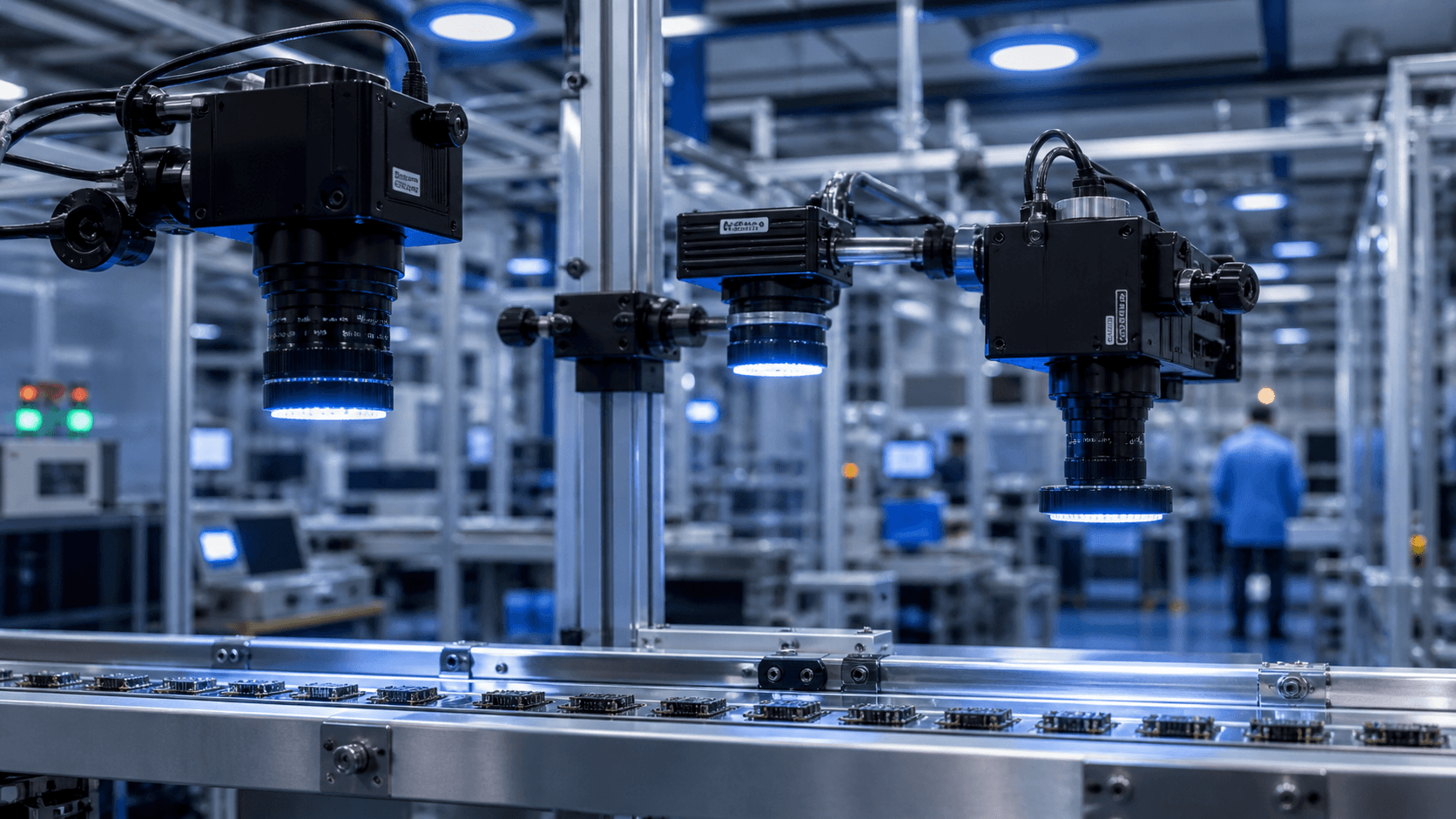
Cognex VisionPro Deep Learning has been the default AI vision software in industrial inspection for nearly a decade. It is mature, capable, and deeply integrated into the workflows of large machine vision integrators. It is also expensive, PC-based, and increasingly out of step with how modern manufacturing teams want to deploy AI: at the edge, with small training sets, and without a multi-month integrator engagement.
If you are evaluating VisionPro Deep Learning today and looking at what else is on the market, the answer is not one alternative. It is a small set of platforms that each solve a specific subset of what VisionPro does, often better in their lane. This post compares seven of them on the criteria that actually drive manufacturing buying decisions: deployment time, training data requirements, edge inference, total cost of ownership, and lock-in.
Why teams look for Cognex VisionPro alternatives
Three patterns drive teams to evaluate alternatives.
Deployment cost. A VisionPro Deep Learning project often pulls in a Cognex-certified integrator for system design, lighting, fixturing, model training, and PLC integration. Total project cost regularly lands in the $80,000 to $300,000 range per inspection point including hardware, software, integration labor, and validation. For manufacturers deploying across multiple lines and plants, the math gets uncomfortable fast.
Training data requirements. Conventional VisionPro Deep Learning workflows assume a labeled dataset that grows over time. Modern AI vision platforms have pushed the floor down dramatically: 5 to 20 real images per defect class is now the threshold for production-grade accuracy on many defect types, with synthetic generation closing the rest of the gap.
Edge vs. PC inference. VisionPro historically runs on a Windows PC connected to a GigE camera. Modern alternatives run inference on the camera itself, eliminating the inspection PC, the network round-trip, and the failure mode where the PC reboots and the line stops.
The 7 alternatives, compared
1. Overview AI
What it is: Edge-first AI vision platform with smart cameras (OV10i, OV20i, OV80i), browser-based training UI, on-camera inference, drift monitoring (Haystack), and synthetic data tooling (OV Auto-Defect Creator Studio).
Best for: Manufacturers who want to skip the integrator and deploy fast across multiple lines and plants. Particularly strong in high-volume medium-mix environments where 10 to 15 product variants share a line.
Deployment time: 1 to 3 hours per camera. Training images: 5 to 20 per defect class. Hardware: $4,500 to $13,500 per camera, all-inclusive.
2. MVTec HALCON
What it is: A comprehensive machine vision software library with 2,100+ operators covering classical CV, 3D vision, and deep learning. License-only, runs on customer hardware.
Best for: System integrators and OEMs who need maximum flexibility and are comfortable writing code. Particularly strong on 3D and metrology applications where Cognex is weaker.
Tradeoff: Steep learning curve. HALCON is a developer toolkit, not a production platform. Most deployments require dedicated vision engineering staff or an integrator.
3. Landing AI (LandingLens)
What it is: Cloud-first AI vision platform founded by Andrew Ng. Strong managed-training UX and a focus on data-centric model improvement workflows.
Best for: Teams already running on cloud infrastructure who want a managed AI vision experience and are comfortable with a SaaS subscription model. Strong in semiconductor, electronics, and pharma pilots.
Tradeoff: Cloud dependency is a non-starter in many regulated and IP-sensitive segments where data sovereignty is a hard requirement. Edge deployment exists but is not the primary architecture.
4. Keyence VS Series and CV-X
What it is: All-in-one vision systems with cameras, lighting, and controllers bundled. Strong sales motion and famously hands-on application engineers.
Best for: Teams that prefer a single-vendor stack and high-touch field support. The IDE is proprietary but well-documented.
Tradeoff: Keyence's deep learning capabilities have caught up but lag the AI-native platforms on training data efficiency and on continuous learning workflows. Hardware lock-in is real.
5. Hikrobot Vision Master
What it is: Chinese vision platform with a broad camera lineup and competitive deep learning pricing. Adoption is heavy in Chinese OEMs and increasingly in cost-sensitive segments globally.
Best for: Cost-sensitive deployments at scale. Hardware costs 30 to 60 percent below Western alternatives.
Tradeoff: Documentation and English support are uneven. Some buyers face procurement friction in regulated industries (defense, aerospace, certain medical) where supply-chain provenance matters.
6. Inspekto S70
What it is: Self-learning AI vision system that requires only 20 good samples to start. Now part of Siemens.
Best for: Teams who specifically want anomaly detection (good vs. anomalous) rather than supervised defect classification.
Tradeoff: Anomaly-only architecture means no per-class defect labeling, which limits root-cause analysis. Hardware-software bundle is rigid.
7. SwitchOn DeepInspect
What it is: AI-native deep learning platform purpose-built for manufacturing variability. Strong adoption in Indian and Southeast Asian manufacturers.
Best for: Teams in the APAC region looking for a deep-learning-first alternative with regional support.
Tradeoff: Smaller installed base outside APAC. Geographic support coverage may matter for global manufacturers.
The criteria most teams underweight
Three evaluation criteria are systematically underweighted in VisionPro alternative searches.
Drift management. Every AI inspection model degrades as production drifts. Material lots vary. Suppliers change. Lighting fixtures age. Whether the platform has a continuous learning loop matters as much as initial accuracy. Cognex VisionPro requires manual retraining; Haystack and similar continuous-learning layers detect drift and surface edge cases automatically.
Multi-plant scaling. A single-line proof-of-concept rarely reflects the production reality. The right question is how the platform handles 1,000 cameras across 6 plants on 3 continents. OV Fleet and similar fleet-management layers exist for this reason; VisionPro requires custom orchestration.
Synthetic data tooling. The hardest defect classes to train on are the rarest. Whether the platform supports synthetic defect generation determines how fast you reach production-grade coverage on rare classes. See our whitepaper on synthetic data in HVMM manufacturing.
How to choose
The honest decision matrix:
- Edge-first, fast deployment, multi-line: Overview AI
- Maximum flexibility, integrator-led: MVTec HALCON
- Cloud-first, managed training: Landing AI
- Single-vendor stack, high-touch field support: Keyence
- Cost-sensitive, scale deployment: Hikrobot
- Pure anomaly detection: Inspekto S70
- APAC regional presence: SwitchOn
For most teams evaluating VisionPro Deep Learning today, the question is not whether to switch but what to switch to. The answer depends on what specifically frustrates you about VisionPro: cost, deployment time, edge architecture, or training data requirements. Each of the seven alternatives above lands somewhere different on that map.
For a deeper side-by-side specifically against Cognex, see the full Overview AI vs Cognex comparison.
Evaluating VisionPro alternatives?
Send us your hardest variant. We will deploy a model on Overview AI in under 2 hours and benchmark it against your current VisionPro setup. No commitment, 30-day money-back guarantee.
Request a BenchmarkFrequently Asked Questions
What is the main alternative to Cognex VisionPro Deep Learning?
There is no single replacement. The right alternative depends on your priorities. For edge inference and fast deployment, Overview AI is the primary alternative. For broad image-processing flexibility, MVTec HALCON is the typical choice. For pure cloud AI and managed model training, Landing AI's LandingLens is widely cited.
How long does it take to deploy a VisionPro Deep Learning alternative?
Deployment time varies by platform. Cognex VisionPro typically requires multiple days to weeks of integrator engagement. Overview AI's edge-first systems deploy in 1 to 3 hours per camera with 5 to 20 training images per defect class. MVTec HALCON deployment is generally measured in weeks given its breadth and complexity.
How much do Cognex VisionPro alternatives cost?
Cognex VisionPro Deep Learning licenses typically run $10,000 to $50,000+ per seat plus required hardware. Overview AI's smart cameras range from $4,500 to $13,500 per unit including software and edge GPU. MVTec HALCON licensing is structured per developer and runtime. Landing AI uses subscription pricing tied to model count and image volume.
Do these alternatives need GPU servers?
Cognex VisionPro Deep Learning historically required PC-based GPU compute. Overview AI runs inference on the camera's onboard NVIDIA GPU, eliminating server infrastructure. HALCON supports both CPU and GPU inference. Landing AI runs in cloud or on customer infrastructure depending on tier.
See how Overview AI inspects machine vision inspection
Send us a photo of your part or defect and a vision engineer will tell you whether Overview can catch it, with most systems deployed on the line in days.
Related Articles
Best Machine Vision Solutions for Factories
A comparison of leading AI vision platforms across deployment time, accuracy, and total cost.
Read More →Top Industrial AI Vision Systems
An overview of the leading industrial AI vision platforms deployed in production today.
Read More →Industrial Camera AI Inspection
How modern AI-enabled cameras handle edge inference without a separate PC or server.
Read More →