AOI vs AI Vision in PCB and Electronics Manufacturing: When AI Actually Beats AOI
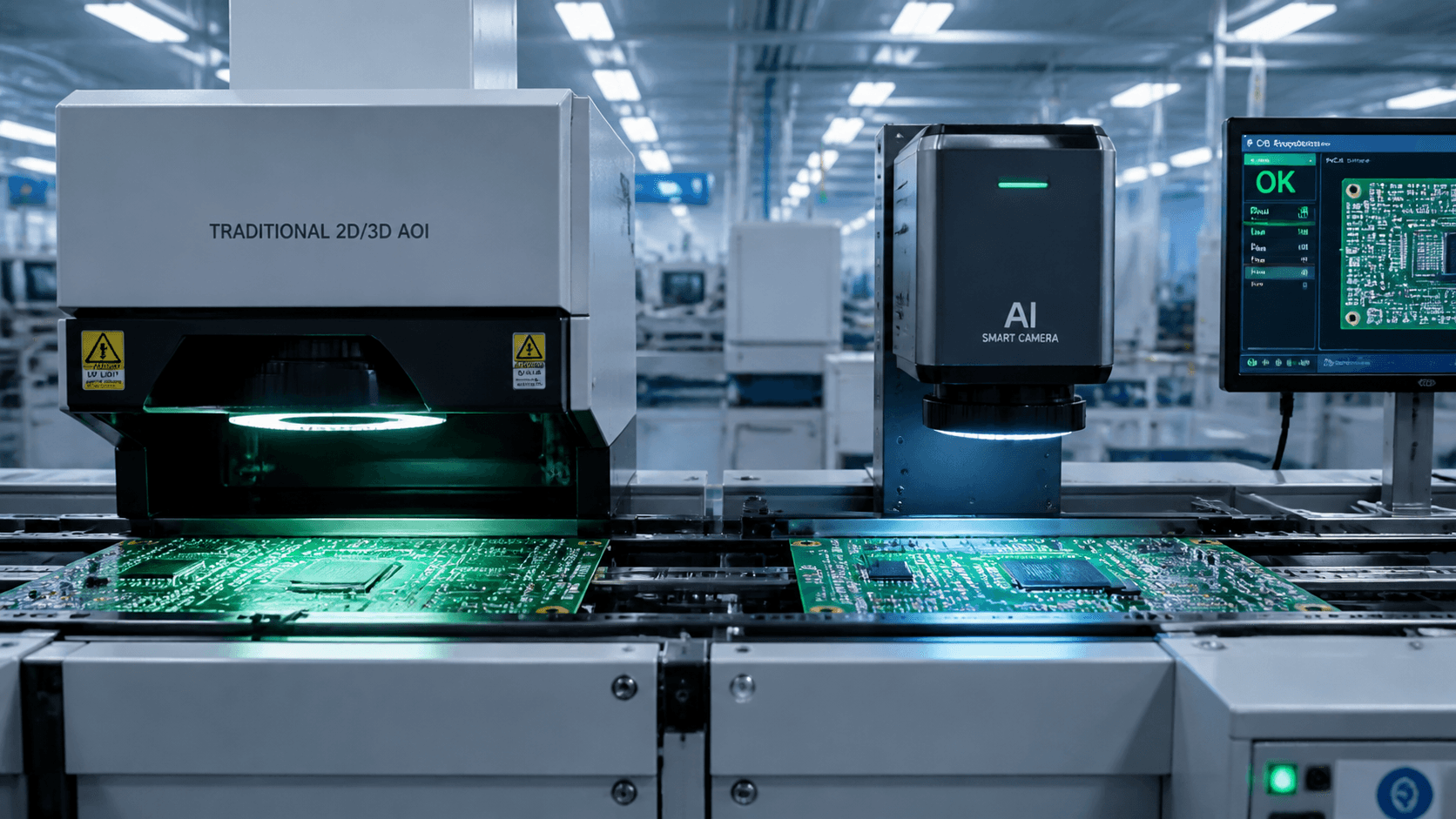
Automated Optical Inspection has been the workhorse of electronics manufacturing for thirty years. Every SMT line of any meaningful volume has at least one AOI machine downstream of reflow, often two more at solder paste inspection (SPI) and post-placement. The technology is mature, the integrators are experienced, and the equipment is good at what it does.
The question that rightly comes up in 2026 is not whether AOI works. It does. The question is whether AI vision works better, and on which specific inspections. The honest answer is that the two approaches are complementary, not substitutes, and the right architecture for most electronics lines today combines both.
This post lays out where each approach wins, where each loses, and the economic and operational signals that should drive the choice.
What AOI is good at
Rule-based AOI is genuinely excellent on inspections that meet three conditions: the inspection target is dimensionally well-bounded, the lighting environment is stable, and the defect classes are limited to a small set of presence-absence or threshold-cross checks.
Examples where AOI continues to dominate:
- Component presence and orientation. Is the resistor there? Is the polarized cap rotated correctly? AOI is fast and reliable.
- Solder paste volume measurement (SPI). 3D AOI measures paste volume directly. AI is unnecessary.
- Mark and label inspection. Date codes, lot codes, barcodes. Pure pattern matching.
- Through-hole pin inspection. Pin presence and protrusion. Geometric.
- Polarity verification. Looking for the correct mark or notch in a known location.
For these inspections, AI vision adds complexity without meaningful accuracy improvement. Stick with AOI.
Where AOI breaks
AOI struggles in three specific situations that drive the bulk of electronics inspection complaints in modern manufacturing.
Subtle solder joint defects
Solder joint quality (sufficient solder, complete fillet, no insufficient wetting, no cold joint) is the central inspection challenge in SMT. The visual difference between an acceptable joint and a marginal one is subtle, varies with paste batch and reflow profile, and depends on the specific component and pad geometry. Rule-based AOI handles the obvious failures (open joints, bridging, missing solder) but generates high false-reject rates on the subtle cases. The result: a hidden second inspection station of human operators reviewing AOI rejects.
AI vision trained on labeled solder joint examples consistently reduces false reject rates from the typical 5 to 15 percent range to under 1 percent on tuned lines, while matching or beating AOI's escape rate. The economic case is the operator review burden, not the underlying defect rate.
Multi-revision and mixed-technology assemblies
Modern contract manufacturers run multiple board revisions through the same SMT line on a regular cadence. Each revision requires its own AOI program with hand-tuned thresholds. The maintenance burden compounds as revisions multiply. Mixed-technology assemblies (fine-pitch BGAs alongside through-hole connectors alongside chip components) push rule-based programs into edge cases the original threshold tuning didn't anticipate.
AI vision handles multi-revision lines by training a model per revision (with shared backbone), with deployment time of 5 to 20 images and under an hour per revision. See our coverage of high-volume medium-mix manufacturing for the deployment shape this enables.
Rare and emerging defect classes
When a new defect class emerges (often after a process change, supplier substitution, or facility move), AOI requires a new program written by an integrator. The lead time is days to weeks. AI vision retrains in minutes when production engineers label the new examples. The continuous learning loop matters more in environments with frequent process change than the model accuracy difference does.
The economic comparison
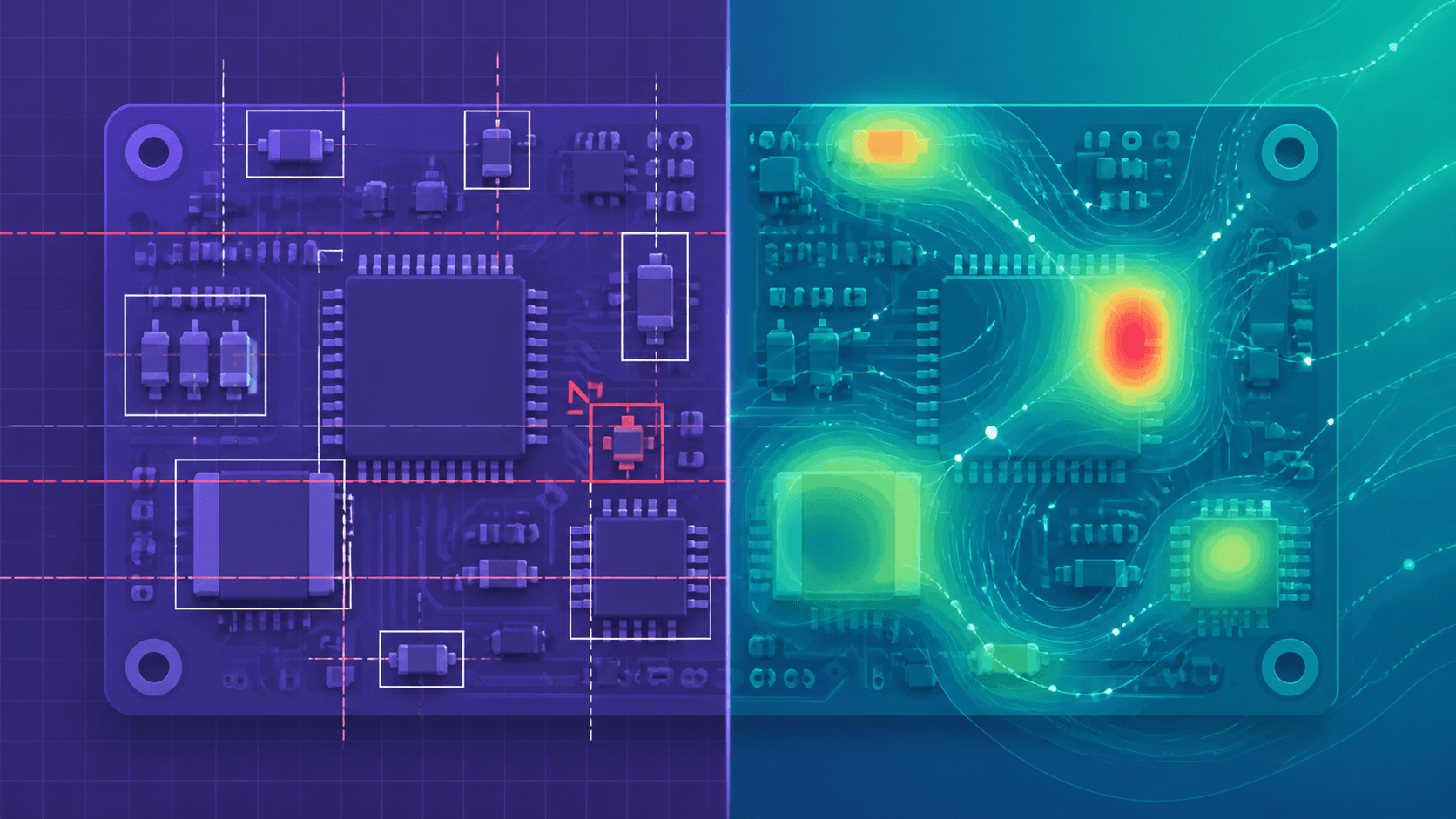
The first-order numbers that drive the decision:
| Metric | AOI | AI Vision |
|---|---|---|
| False reject rate | 5–15% | ≤1% |
| Deploy time per revision | Days to weeks | 1–2 hours |
| Training data needed | Hand-tuned rules | 5–20 images per class |
| Ongoing tuning | Per process change | Drift-monitored, auto-flagged |
| Hardware cost | $80K–$300K per AOI | $4.5K–$13.5K per camera |
The hardware cost line is misleading on its own. AOI machines and AI vision smart cameras are not direct substitutes. Most lines that adopt AI vision keep their existing AOI in place and add AI vision at specific points where AOI struggles (post-reflow joint inspection, conformal coat inspection, final visual). The economic case is the reduction in operator review burden plus the elimination of escapes on the defect classes AOI was already missing.
Where to add AI vision to an existing AOI line
The most common deployment pattern is augmentation, not replacement. Three positions are typical:
Post-reflow solder joint review. AI vision sits downstream of AOI, looking specifically at the joints AOI flagged as borderline. Replaces the manual operator review station. Drops the false reject rate dramatically without touching the underlying AOI program.
Final cosmetic inspection. AI vision after AOI for cosmetic defects (scratches, label damage, conformal coat coverage, mark legibility) that AOI handles unreliably. See connector inspection for zero-defect PCBA for one such deployment pattern.
Mixed-technology and high-mix lines. When the variety of board revisions and component types breaks AOI program maintenance economics, AI vision becomes the primary inspector with AOI relegated to specific high-throughput components.
The decision framework
The questions worth asking before committing to either approach:
- How many board revisions run through this line per quarter? One: AOI is fine. Five or more: AI vision saves more than it costs.
- What is your AOI false reject rate today? Above 5 percent: there is a strong economic case to switch on the worst-performing defect classes.
- How many operators are reviewing AOI rejects? Each operator hour saved is direct labor cost recovery.
- Are escapes reaching customers? If yes, the question is which specific defect classes AOI is missing, and whether AI vision catches them better.
- How fast does your process change? Frequent process change favors AI vision's faster retraining cycle. Stable process favors AOI's mature tuning.
The honest answer for most contract electronics manufacturers in 2026 is hybrid. AOI continues to handle the high-volume, low-variability inspections it was built for. AI vision handles the subtle joint defects, the multi-revision burden, and the rare defect classes AOI was always going to miss. The total inspection cost goes down and the escape rate goes down at the same time.
Getting started
For the broader picture on PCB AI vision deployment, see PCB inspection with AI vision. For specific connector inspection challenges in zero-defect PCBA, see connector inspection for zero-defect PCBA.
Augmenting an AOI line with AI vision?
Send us samples from your highest false-reject AOI station. We will train an AI vision model on your actual defect classes and benchmark it against your current AOI false-reject and escape rates. 30-day money-back pilot.
Request an AOI Augmentation PilotSee how Overview AI inspects AOI vs AI vision
Send us a photo of your part or defect and a vision engineer will tell you whether Overview can catch it, with most systems deployed on the line in days.
Related Articles
AI Vision for PCB Inspection: Catch Solder Defects, Protect Yield
Detect solder bridges, tombstones, and polarity errors with pose-tolerant models and edge inference that protect first-pass yield.
Read More →Connector Inspection: Achieving Zero-Defect PCBA Manufacturing
How AI vision detects bent pins, terminal seating issues, and solder anomalies for zero-defect PCBA lines.
Read More →AI Vision for Semiconductor Wafer Inspection
Detecting sub-micron wafer and die defects to protect yield across advanced chip production.
Read More →