Stamped Shield with Coining Marks Affecting EMI Seal: A Machine Vision Inspection Guide
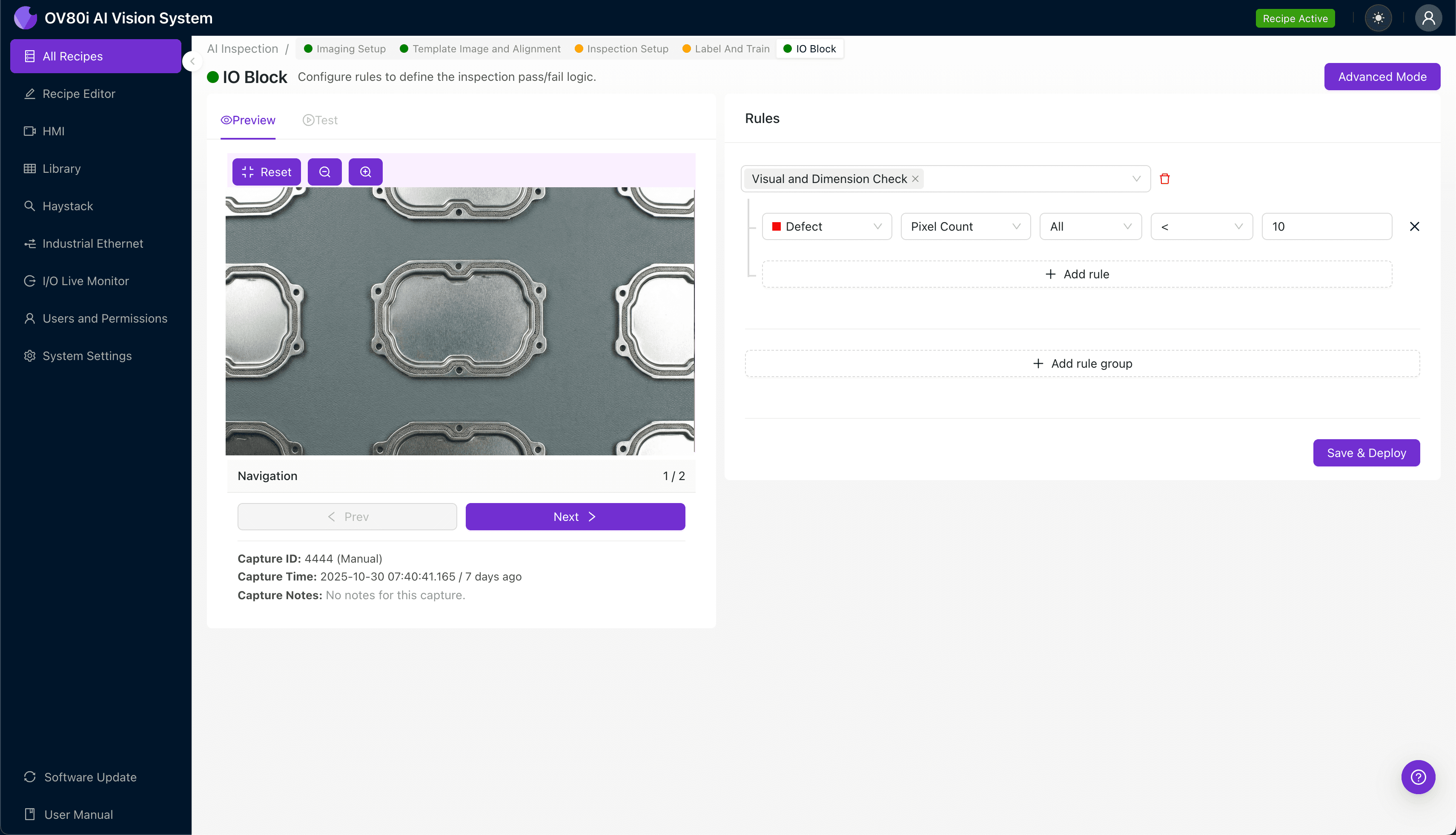
"Coining mark defects on stamped EMI shields create seal interface failures that compromise EMC compliance. AI-powered machine vision detects micron-level variations in coining depth, alignment, and surface quality at full production speed—ensuring every shield meets seal integrity requirements."
The Problem: Why Coining Mark Defects Compromise EMI Shielding Performance
Stamped metal shields are critical components in electronic assemblies, providing electromagnetic interference (EMI) protection for sensitive circuits. When coining operations produce inconsistent marks or surface irregularities, the resulting seal interface failures can render entire assemblies non-compliant with EMC standards.
Common Defects in Stamped Shields with Coining Marks
- Incomplete coining depth — shallow impressions that fail to create proper seal contact surfaces
- Coining mark misalignment — off-center or skewed marks that prevent uniform gasket compression
- Surface burrs at coin edges — raised material that creates gaps in the EMI seal interface
- Material flow irregularities — uneven metal displacement causing seal surface waviness
- Cracking at coin boundaries — micro-fractures from excessive forming pressure or material fatigue
- Dimensional variation in coin geometry — inconsistent mark profiles affecting seal-to-shield mating
Human inspectors struggle with these defects due to their subtle, repetitive nature. Fatigue sets in quickly when examining hundreds of identical shields per hour, and the micron-level variations in coining depth are often invisible to the naked eye under production lighting conditions.
The Solution: AI-Powered Visual Inspection for EMI Shield Quality
Machine vision systems equipped with deep learning algorithms excel at detecting the subtle surface variations that define coining quality. Unlike rule-based systems that require explicit programming for each defect type, neural networks learn to recognize the complex patterns that differentiate acceptable parts from rejects.
Overview.ai's approach delivers consistent, objective inspection at full line speed—examining every stamped shield without the variability inherent in manual sampling methods. The OV80i platform processes high-resolution images in milliseconds, flagging suspect parts before they advance to assembly operations where rework costs multiply.
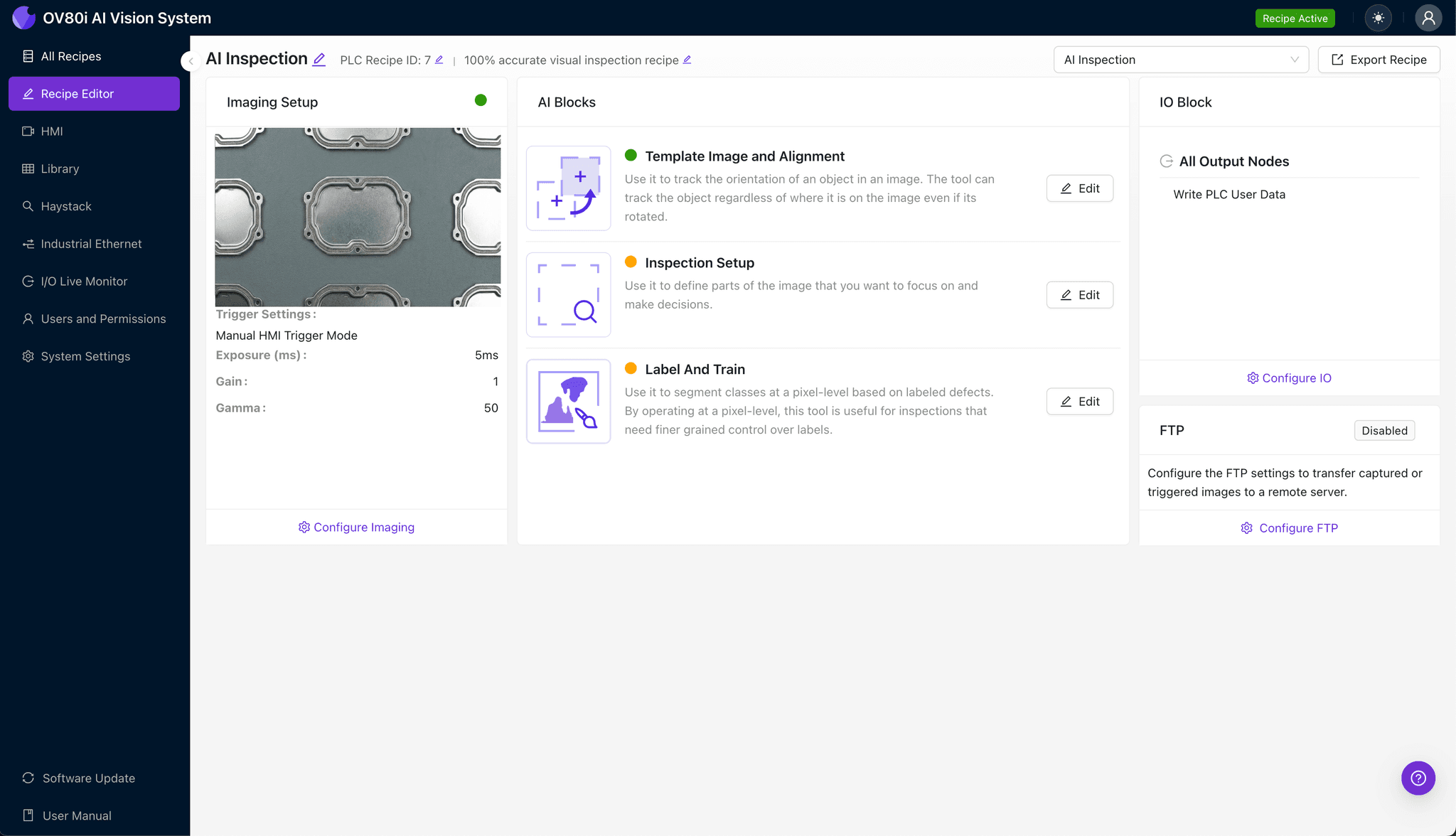
Step 1: Imaging Setup
Position the stamped shield under the camera with the coining marks facing upward, ensuring the EMI seal contact surfaces are fully visible within the field of view. Proper fixturing at this stage is essential—the shield should sit flat and stable to eliminate shadows or reflections that could obscure critical features.
Click "Configure Imaging" to access the Camera Settings panel. Adjust exposure to reveal surface texture detail in the coined areas without washing out highlights, and fine-tune gain to balance signal strength against image noise.
Click "Save" to lock in your imaging parameters before proceeding.
Step 2: Image Alignment
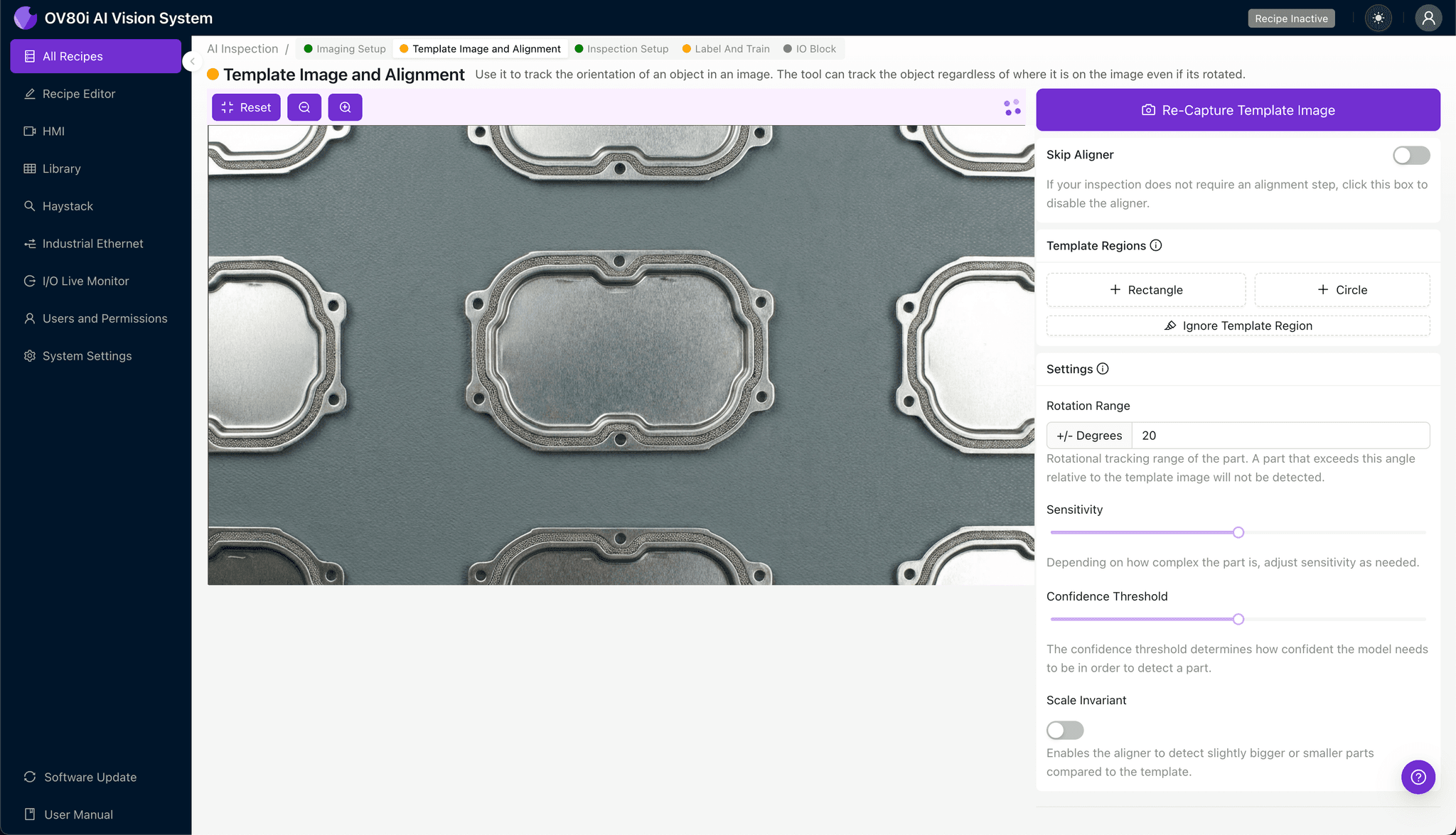
Navigate to "Template Image" in the configuration menu. Capture a Template using a known-good shield that represents the ideal part orientation and coining mark placement.
Click "+ Rectangle" to add a region around the main body of the shield, encompassing all coining marks and seal contact areas. This region teaches the system how to locate and orient incoming parts.
Set the "Rotation Range" to 20 degrees to accommodate typical part placement variation on the conveyor or inspection fixture.
Step 3: Inspection Region Selection
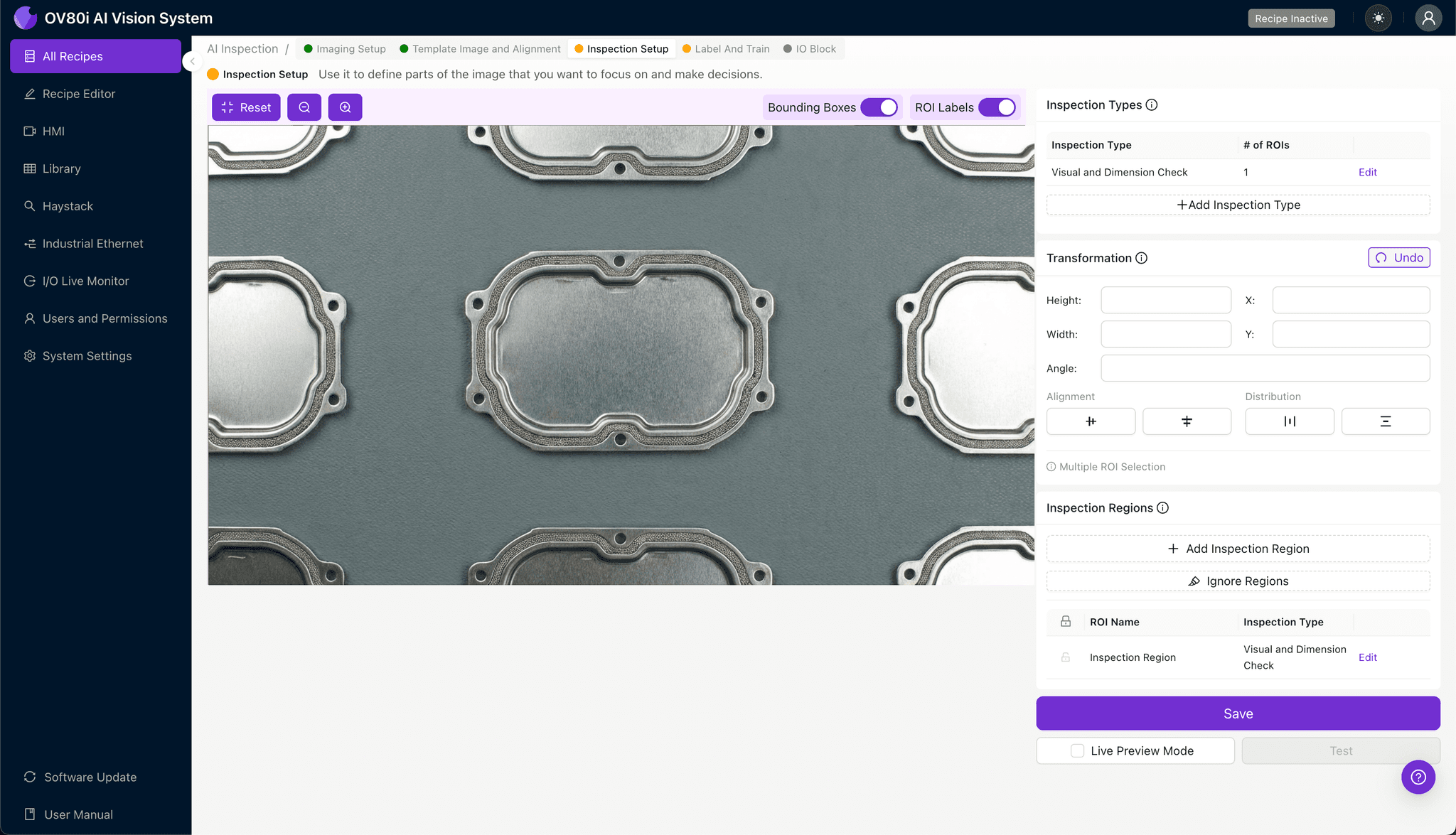
Navigate to "Inspection Setup" to define where the system should focus its analysis. Rename your "Inspection Types" with descriptive labels such as "Coining_Depth_Zone" or "Seal_Surface_Area" for clarity in production reports.
Click "+ Add Inspection Region" to create targeted analysis zones. Resize the yellow bounding box over each critical defect area—specifically the coined surfaces and the perimeter seal interface where gasket contact occurs.
Click "Save" after positioning all inspection regions.
Step 4: Labeling Data
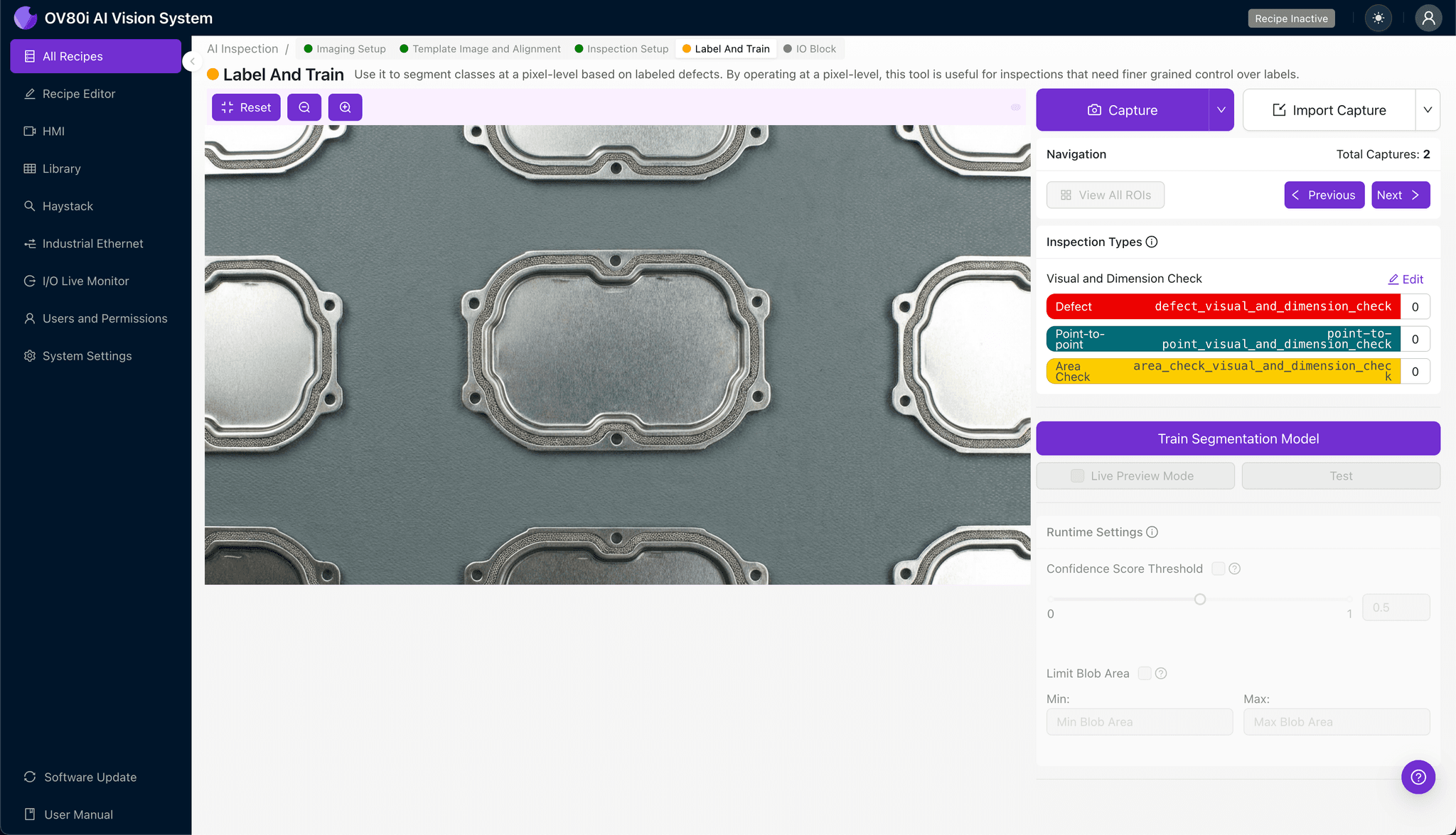
The human-in-the-loop labeling process is where your manufacturing expertise trains the AI model. As shields pass through the system, operators review captured images and categorize them as Good (acceptable coining) or Bad (defective).
Include representative samples across the full range of acceptable variation, as well as known failure modes from your quality history. The model learns best from diverse examples—shallow coins, misaligned marks, edge burrs, and borderline cases all contribute to robust detection performance.
Step 5: Creating Rules
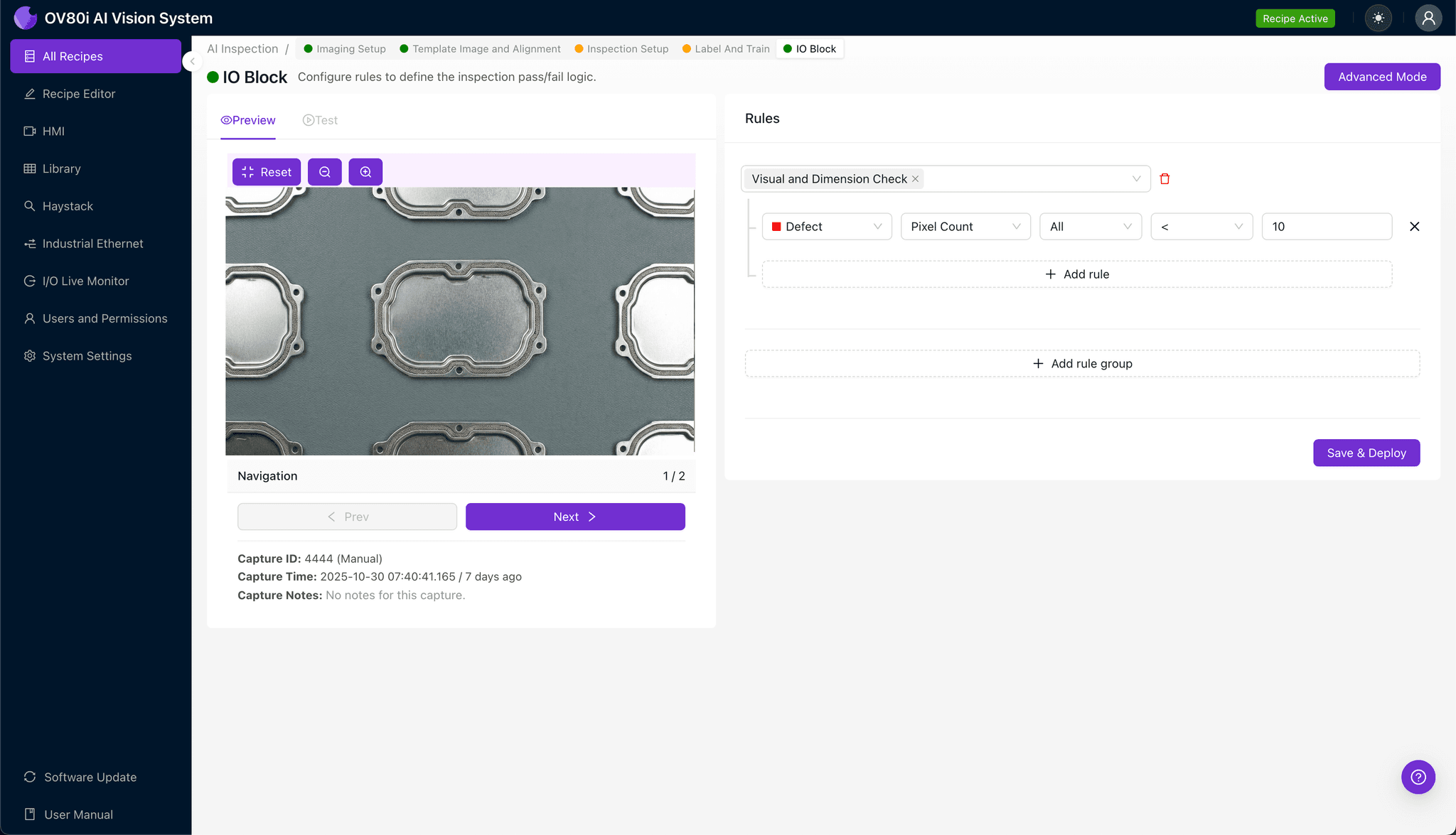
Configure pass/fail logic based on your defined Inspection Types. Set thresholds that reflect your quality specifications—for example, requiring all three coining zones to pass for overall part acceptance.
Gate automated acceptance on the line by linking inspection results to reject mechanisms or diverter stations. Parts flagged as defective are automatically segregated, ensuring only conforming shields proceed to EMI gasket application and final assembly.
Key Outcomes & ROI
Implementing automated visual inspection for stamped EMI shields delivers measurable business impact:
- Reduced scrap rates — catch coining defects before value-added assembly operations multiply rework costs
- Higher throughput — inspect 100% of parts at line speed without creating inspection bottlenecks
- Compliance and traceability — generate timestamped inspection records for every shield, supporting automotive and aerospace EMC documentation requirements
- Process improvement insights — trend analysis of defect patterns reveals upstream tooling wear or press setting drift before quality escapes occur
Conclusion
Stamped shields with coining marks represent a challenging inspection application where traditional methods consistently underperform. By deploying Overview.ai's machine vision platform, manufacturers gain the detection sensitivity and throughput capacity needed to guarantee EMI seal integrity—protecting both product performance and brand reputation.
Eliminate Coining Defects Today
Stop relying on manual inspection for critical EMI shield quality. Deploy Overview.ai to catch coining mark defects instantly.