How to Detect Excessive Camber (Twisting) in Leadframe Strips Using AI-Powered Visual Inspection
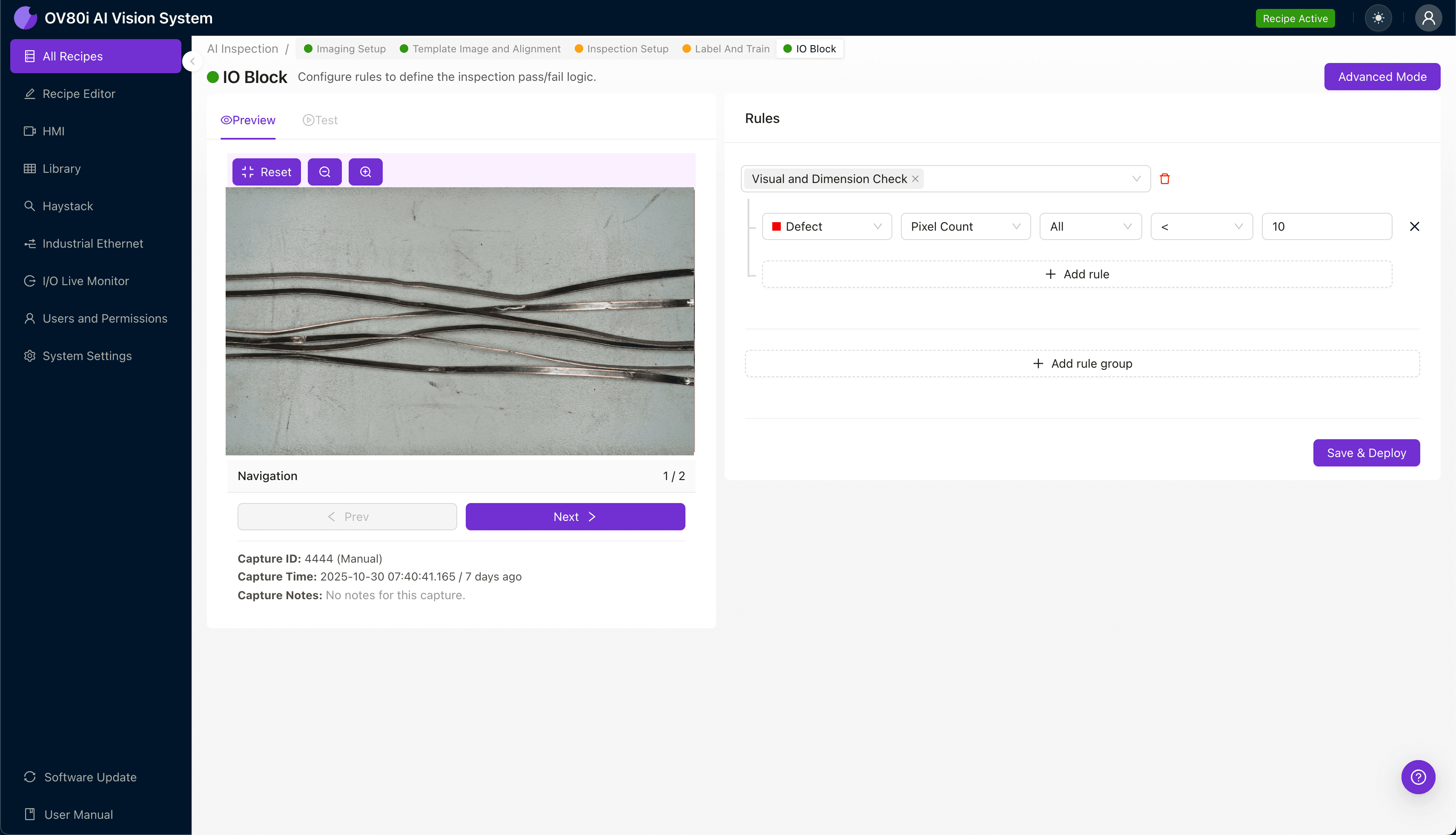
"Excessive camber in leadframe strips causes assembly failures and material waste. AI-powered visual inspection detects subtle twisting and curvature defects at line speed, ensuring 100% inspection coverage and eliminating the inconsistency of manual evaluation."
The Problem: Why Camber Defects in Leadframe Strips Are So Costly
Leadframe strips are the backbone of semiconductor packaging, providing the critical structural foundation that connects integrated circuits to the outside world. When these precision components develop excessive camber or twisting defects, the consequences ripple through your entire production line.
Excessive camber in leadframe strips occurs when the material develops unwanted curvature or twisting along its length, compromising the dimensional stability required for downstream assembly processes. This deformation can originate from rolling mill inconsistencies, improper coiling tension, or thermal stresses during stamping operations.
Common Defects Associated with Excessive Leadframe Camber:
- Longitudinal bow — Curvature along the strip's length axis exceeding tolerance specifications
- Lateral camber — Side-to-side deviation causing misalignment during die attach
- Edge wave distortion — Rippling along strip edges from uneven stress distribution
- Twist deformation — Helical warping that prevents proper seating in assembly fixtures
- Coil set memory — Residual curvature from improper storage or unwinding tension
- Localized buckling — Concentrated deformation zones from stamping tool wear
Manual inspection of leadframe camber fails because the defects are often subtle, measured in fractions of a millimeter across long strip lengths. Inspector fatigue sets in quickly when evaluating thousands of identical strips per shift, and the human eye cannot consistently detect gradual deviations that fall just outside tolerance boundaries.
The Solution: Machine Vision and Deep Learning for Camber Detection
Machine vision systems eliminate the subjectivity and inconsistency inherent in manual leadframe inspection. By capturing high-resolution images and analyzing them with deep learning algorithms, these systems detect camber deviations that would be invisible to even the most experienced human inspectors.
Overview.ai's approach delivers consistent, objective inspection at full line speed—ensuring every leadframe strip is evaluated against the same rigorous standards. The system learns from real production data, continuously improving its ability to distinguish acceptable variation from reject-worthy camber defects.
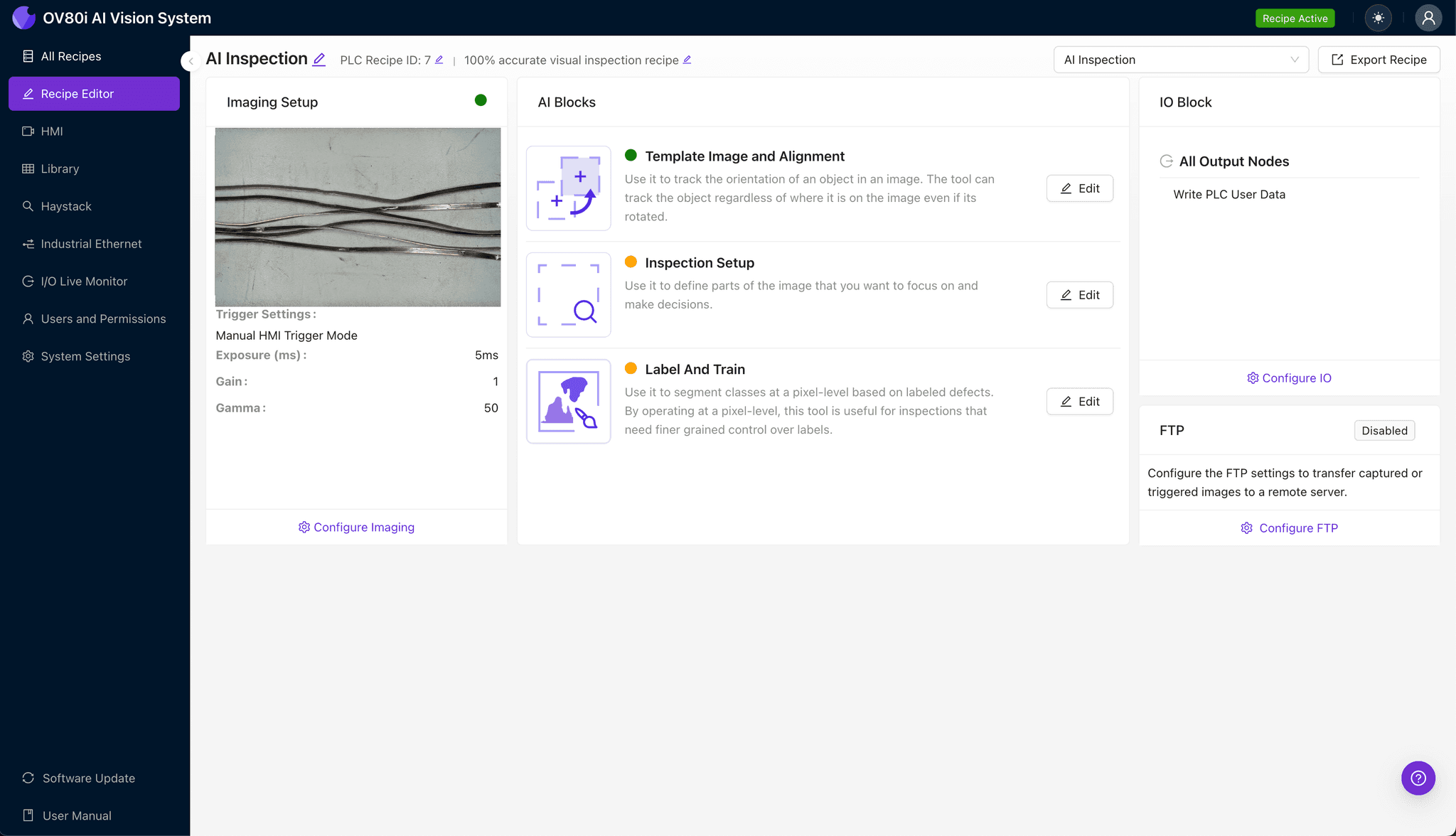
Step 1: Imaging Setup
Position the leadframe strip under the camera system, ensuring the full width and a representative length section are visible in the field of view. Proper lighting is critical for camber detection—angled illumination helps reveal surface deviations and shadow patterns that indicate twisting.
Click "Configure Imaging" to access the Camera Settings panel. Adjust the exposure to capture crisp edge definition without overexposure, and fine-tune the gain to optimize contrast across the metallic surface.
Click "Save" to lock in your imaging configuration.
Step 2: Image Alignment
Navigate to "Template Image" and capture a reference image of a known-good leadframe strip. This template serves as the baseline for aligning all subsequent inspection images.
Click "+ Rectangle" to add an alignment region around the main body of the leadframe strip, focusing on consistent geometric features like pilot holes or lead patterns. Set the "Rotation Range" to 20 degrees to accommodate normal positioning variation during transport.

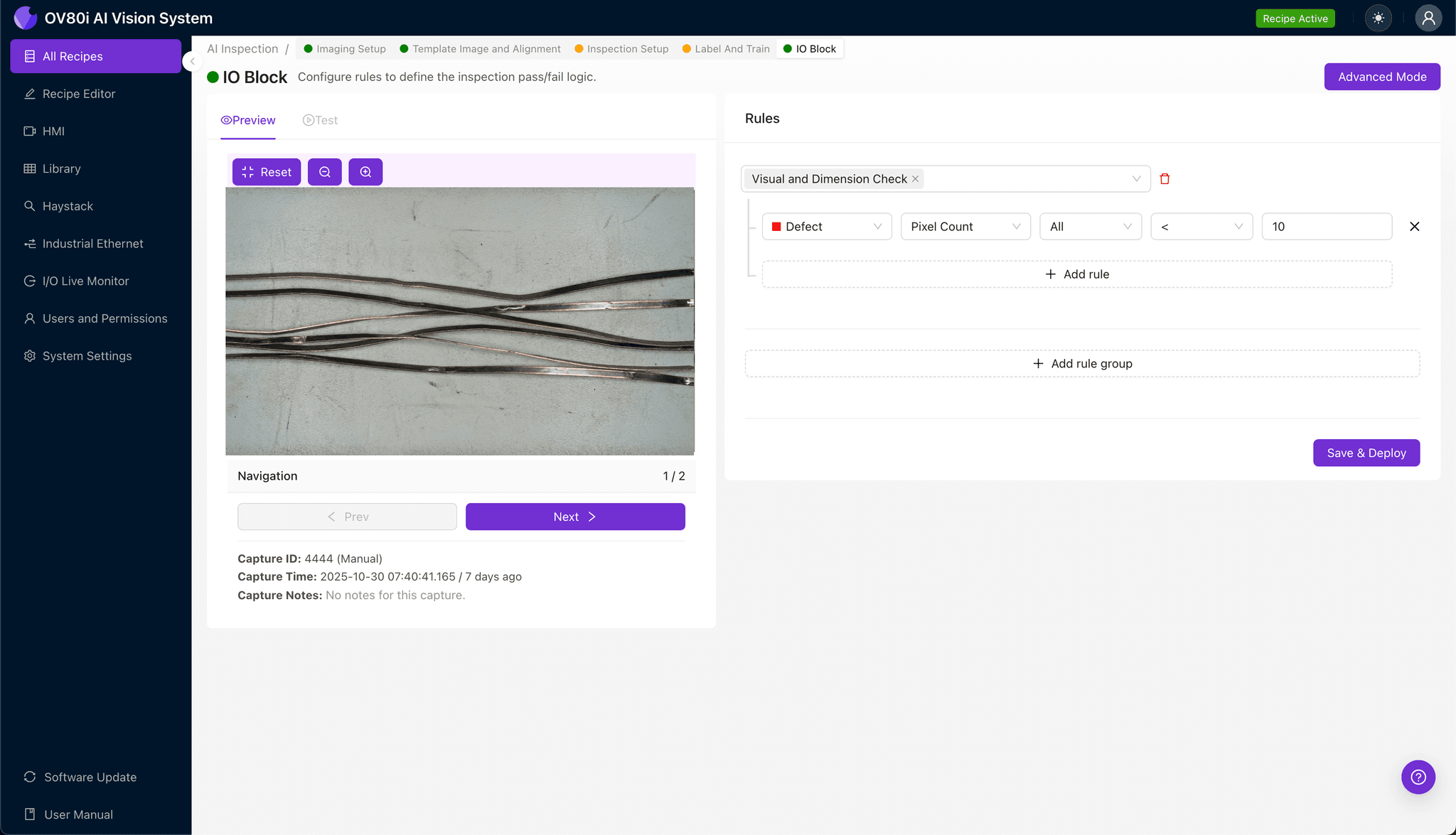
Step 3: Inspection Region Selection
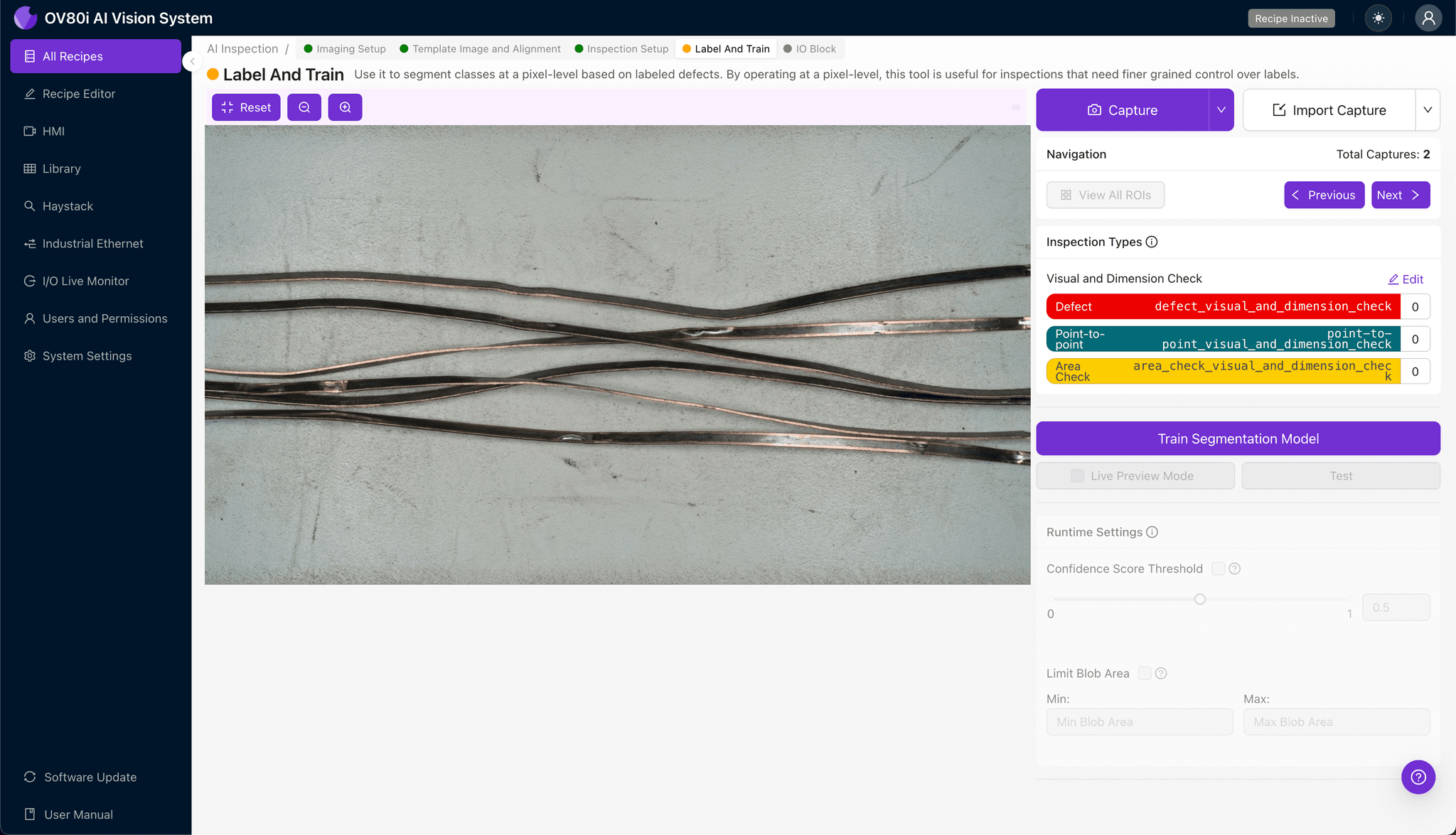
Navigate to "Inspection Setup" to define where the system should look for camber defects. Rename your "Inspection Types" to reflect the specific defect categories—for example, "Longitudinal Camber," "Edge Wave," and "Twist Deformation."
Click "+ Add Inspection Region" for each critical zone. Resize the yellow bounding box to cover the edge profiles, center rail, and lead finger areas where camber manifests most visibly.
Click "Save" to confirm your inspection regions.
Step 4: Labeling Data
The human-in-the-loop labeling process trains the AI to recognize what constitutes acceptable versus rejectable camber. Quality engineers review captured images and classify them as Good or Bad based on established tolerance criteria.
Include representative samples across the full spectrum of production variation. Ensure your labeled dataset contains known failure modes—strips with documented camber measurements that exceeded specifications during quality audits.
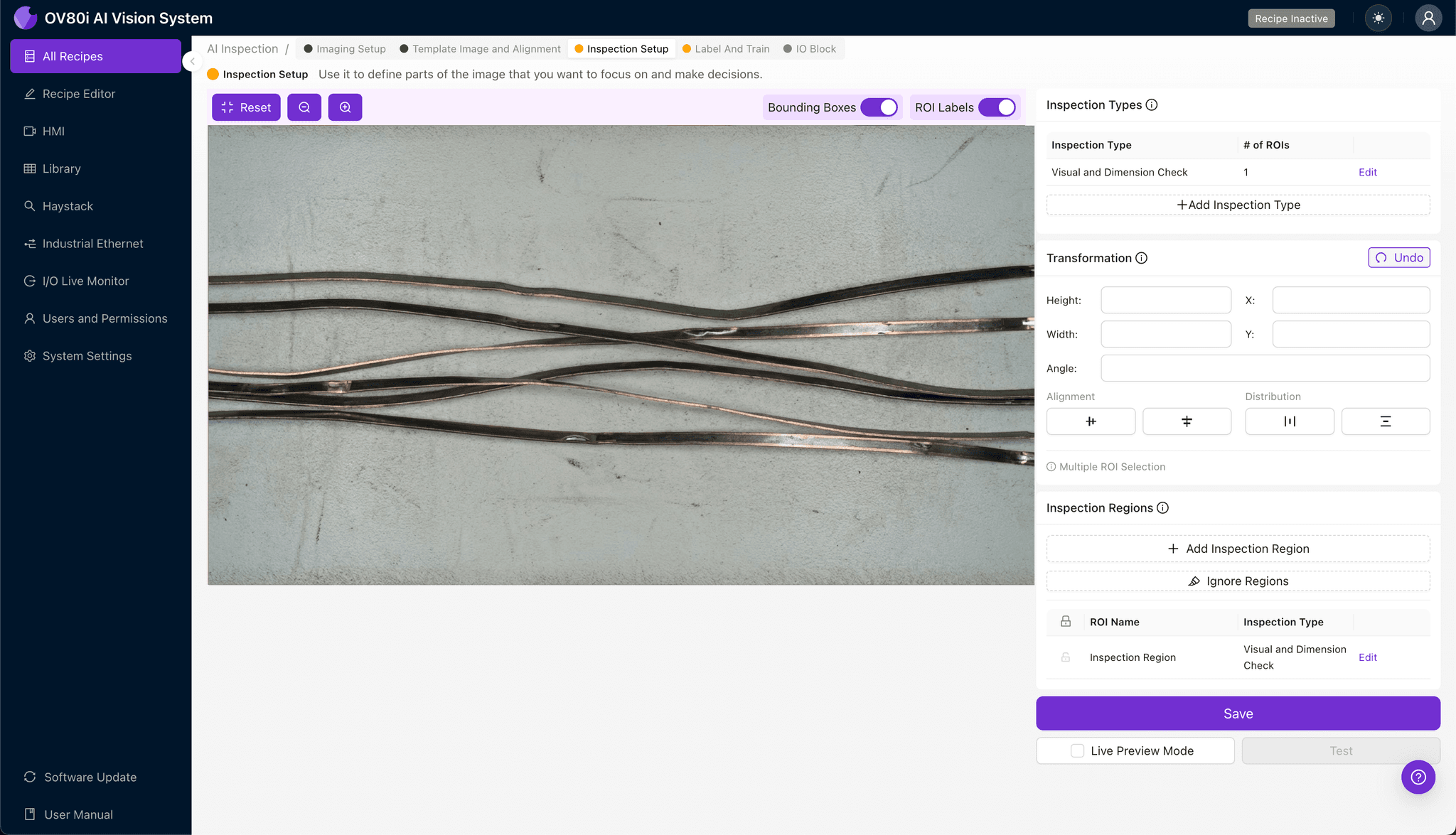
Step 5: Creating Rules
Set your pass/fail logic based on the Inspection Types you defined earlier. Configure threshold sensitivity to match your quality requirements—tighter tolerances for aerospace applications, for example.
Gate automated acceptance on the line so that strips flagged for excessive camber are automatically diverted for secondary inspection or rejection. This closed-loop approach prevents defective material from advancing to wire bonding or encapsulation.
Key Outcomes & ROI
Implementing AI-powered camber inspection delivers measurable business value:
- Reduced scrap rates — Catch camber defects before they cause downstream assembly failures and material waste
- Higher throughput — Inspect 100% of production at line speed without creating bottlenecks
- Enhanced compliance and traceability — Maintain detailed inspection records for automotive and aerospace quality audits
- Process improvement insights — Identify upstream root causes by correlating camber trends with specific coil lots or stamping tools
Conclusion
Excessive camber in leadframe strips doesn't have to be an accepted cost of doing business. With Overview.ai's visual inspection platform, manufacturers gain the ability to detect, document, and eliminate twisting defects before they impact yield or customer satisfaction.
Eliminate Leadframe Camber Defects Today
Stop relying on manual inspection. Deploy Overview.ai to catch twisting and camber defects instantly at full line speed.