Formed Contact with Elastic Spring-Back Deviation: A Complete Visual Inspection Guide
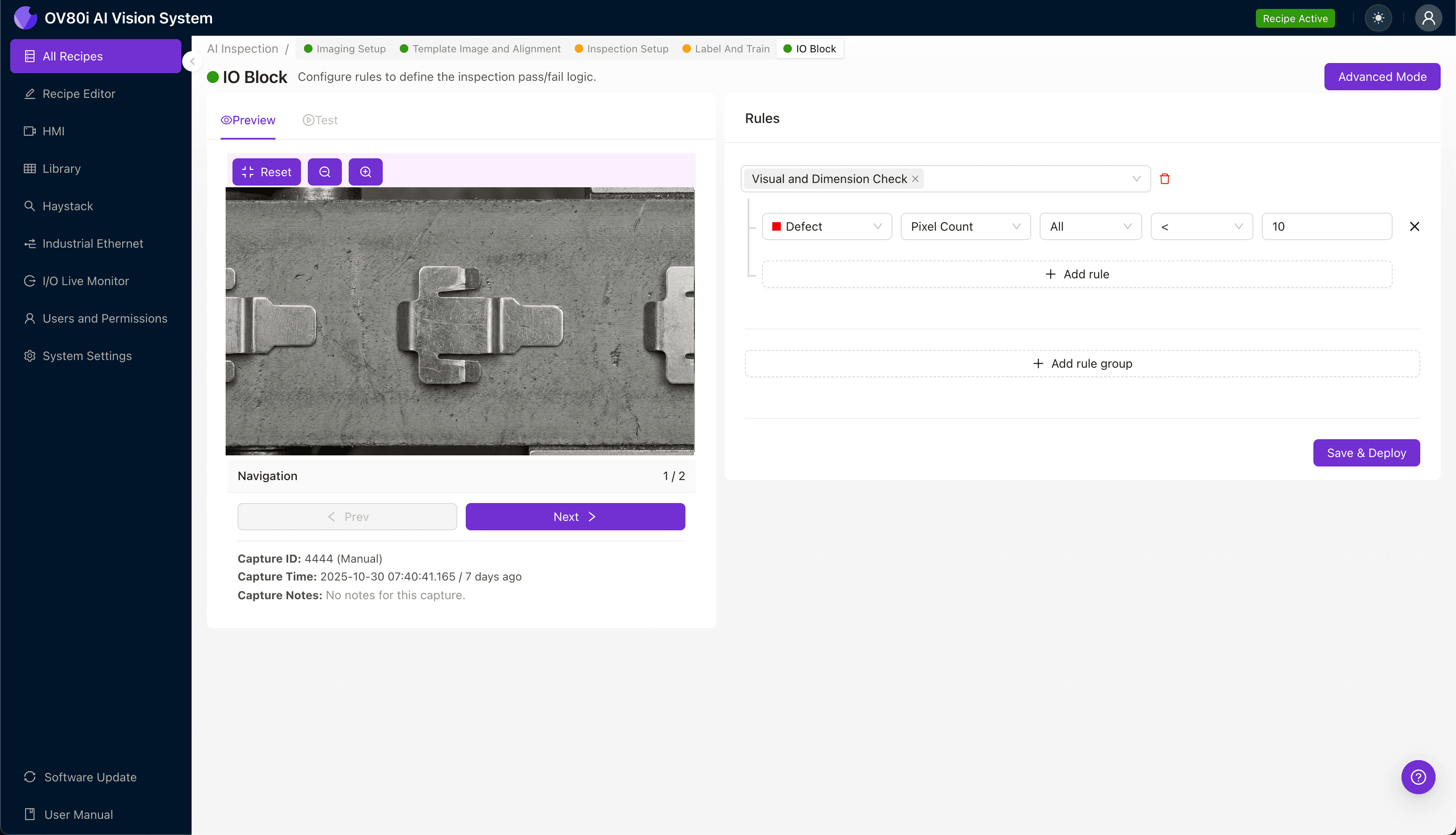
"Elastic spring-back deviation in formed contacts causes dimensional inconsistencies that human inspectors cannot reliably detect. Deep learning-powered vision systems evaluate every part at production speed, catching subtle angular deviations that would otherwise escape to customers."
The Problem: Why Spring-Back Defects Slip Through
Formed contacts are critical components in electrical connectors, and elastic spring-back deviation represents one of the most challenging quality control issues in stamping and forming operations. When metal doesn't hold its intended shape after forming, the resulting dimensional inconsistencies can cause catastrophic failures in the field.
Common Defects Associated with Spring-Back Deviation:
- Over-bend compensation errors — contact angle exceeds specification due to incorrect tooling adjustment
- Under-bend failures — insufficient deformation leaves contacts outside acceptable tolerance windows
- Asymmetric spring-back — uneven material recovery creates twisted or canted contact geometries
- Variable contact gap spacing — inconsistent distances between mating surfaces affect electrical performance
- Work hardening variations — material property differences cause unpredictable elastic recovery
- Edge curl and lip deformation — secondary distortions at bend radii from residual stress release
Manual inspection of these defects is fundamentally unreliable. Human inspectors experience fatigue-induced accuracy drops of up to 30% over a single shift, and the subtle angular deviations involved—often measured in fractions of a degree—exceed the limits of unaided visual perception at production speeds.
The Solution: Machine Vision and Deep Learning
Traditional rule-based vision systems struggle with spring-back deviation because the defect manifests as a continuous spectrum rather than a binary pass/fail condition. Deep learning changes this equation entirely, enabling inspection systems to learn the subtle visual signatures that distinguish acceptable variation from rejectable deviation.
Neural networks trained on thousands of labeled examples develop an intuitive understanding of what "good" looks like—including acceptable tolerance bands that would be impossible to define through explicit programming.
Overview.ai's approach delivers consistent, objective inspection at full line speed. The OV80i system evaluates every single part against learned quality standards, eliminating the sampling-based approaches that allow defective contacts to reach customers.
Step 1: Imaging Setup
Position the formed contact under the OV80i camera system, ensuring the critical bend zones and contact surfaces are clearly visible. Consistent part presentation is essential—consider fixturing that maintains repeatable orientation.
Click "Configure Imaging" in the Overview interface to access the Camera Settings panel. Adjust exposure to capture crisp edge definition at bend radii, and tune gain to reveal subtle surface variations without introducing noise.
Click "Save" to lock in your optimized imaging parameters.
Step 2: Image Alignment
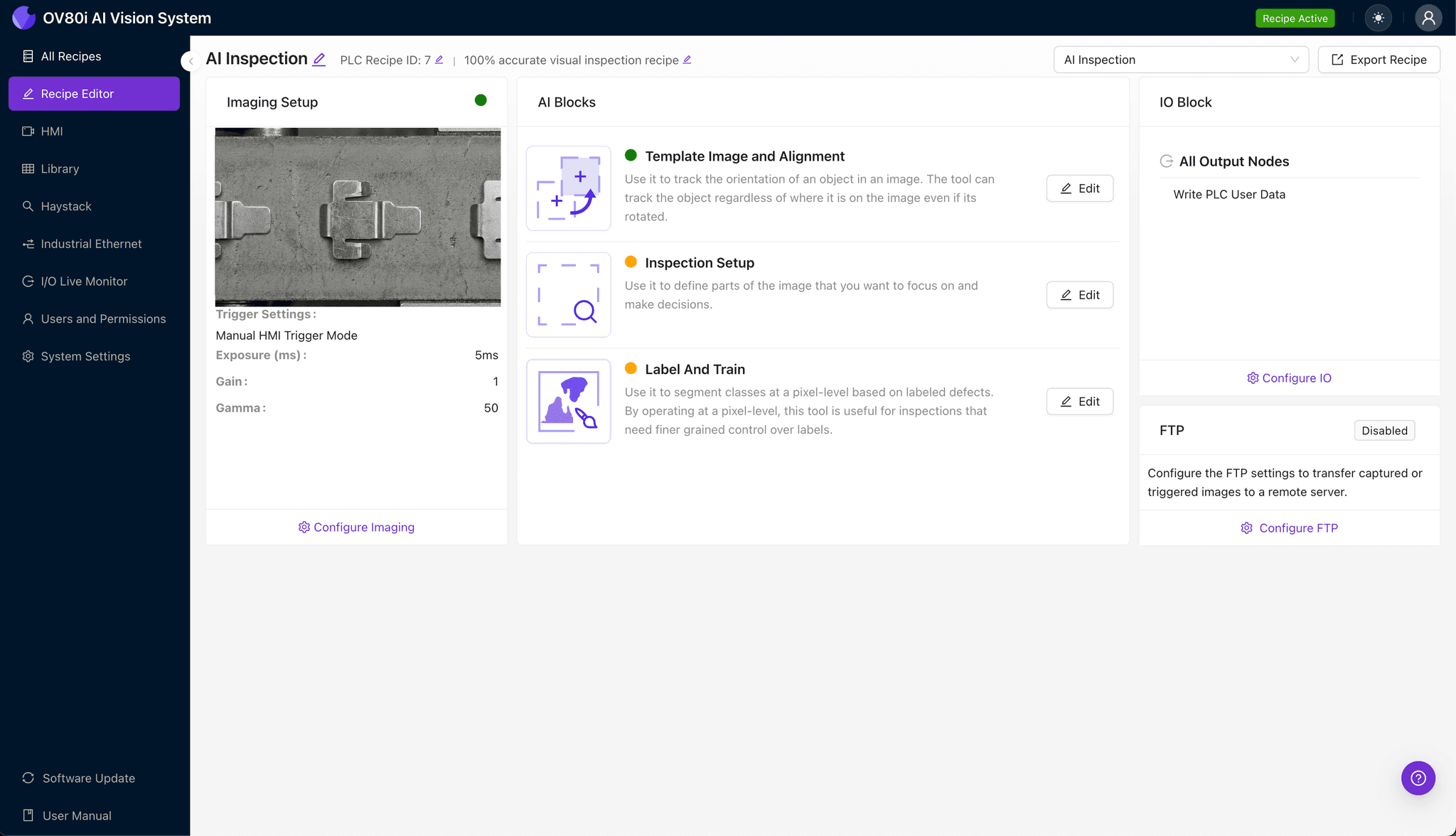
Navigate to the "Template Image" section within the configuration menu. Capture a Template using a known-good contact that represents your ideal formed geometry.
Click "+ Rectangle" to add an alignment region around the main body of the contact. Position this rectangle to encompass stable geometric features that won't vary between good parts.
Set the "Rotation Range" to 20 degrees to accommodate minor orientation differences in part presentation while maintaining reliable alignment.
Step 3: Inspection Region Selection
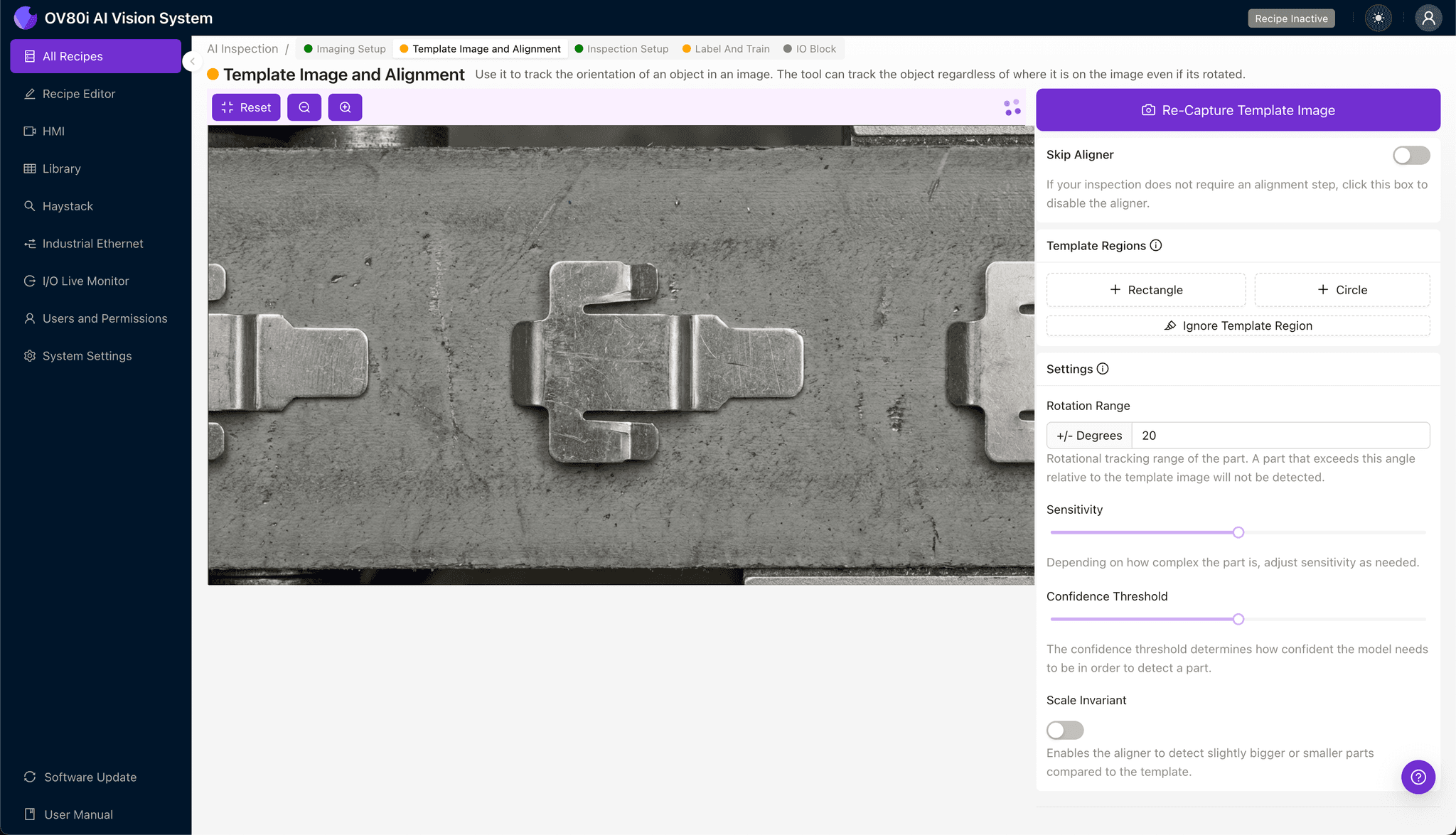
Navigate to "Inspection Setup" to define where the system should focus its analysis. This step is critical for spring-back detection, as you're directing the AI's attention to the zones where deviation manifests.
Rename your "Inspection Types" to reflect the specific failure modes: "Primary Bend Angle," "Contact Gap," or "Tip Alignment."
Click "+ Add Inspection Region" for each critical area. Resize the yellow bounding box to cover bend radii, contact tips, and gap zones where spring-back deviation is most visible.
Click "Save" to confirm your inspection regions.

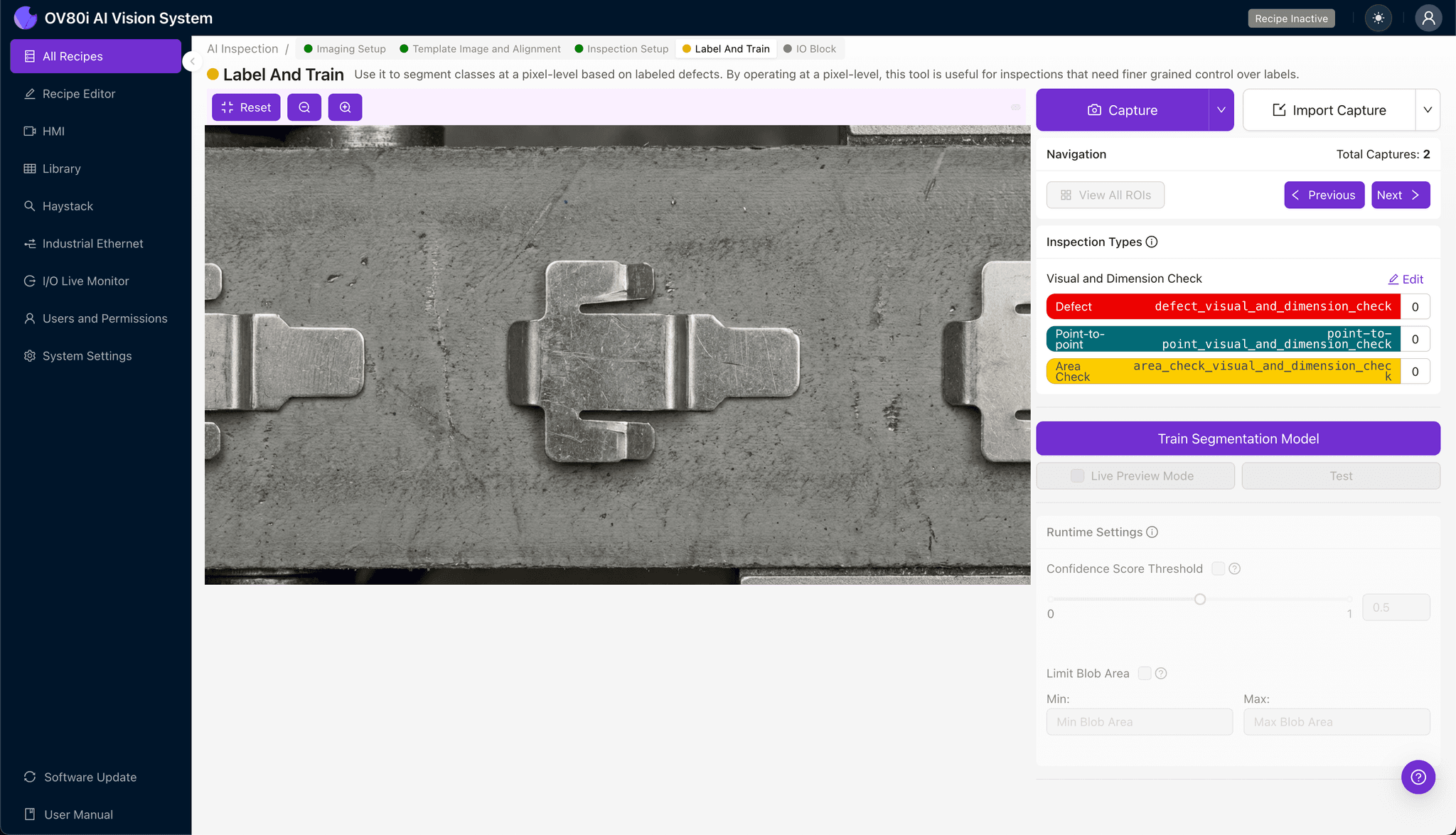
Step 4: Labeling Data
The human-in-the-loop labeling process is where your quality expertise becomes embedded in the AI model. This step transforms tribal knowledge into systematic, repeatable inspection capability.
Review captured images and label each as Good or Bad based on your quality standards. Be decisive—ambiguous labels create ambiguous models.
Include representative samples across your full range of acceptable variation. Critically, incorporate known failure modes and boundary cases to teach the system exactly where your tolerance limits lie.
Step 5: Creating Rules
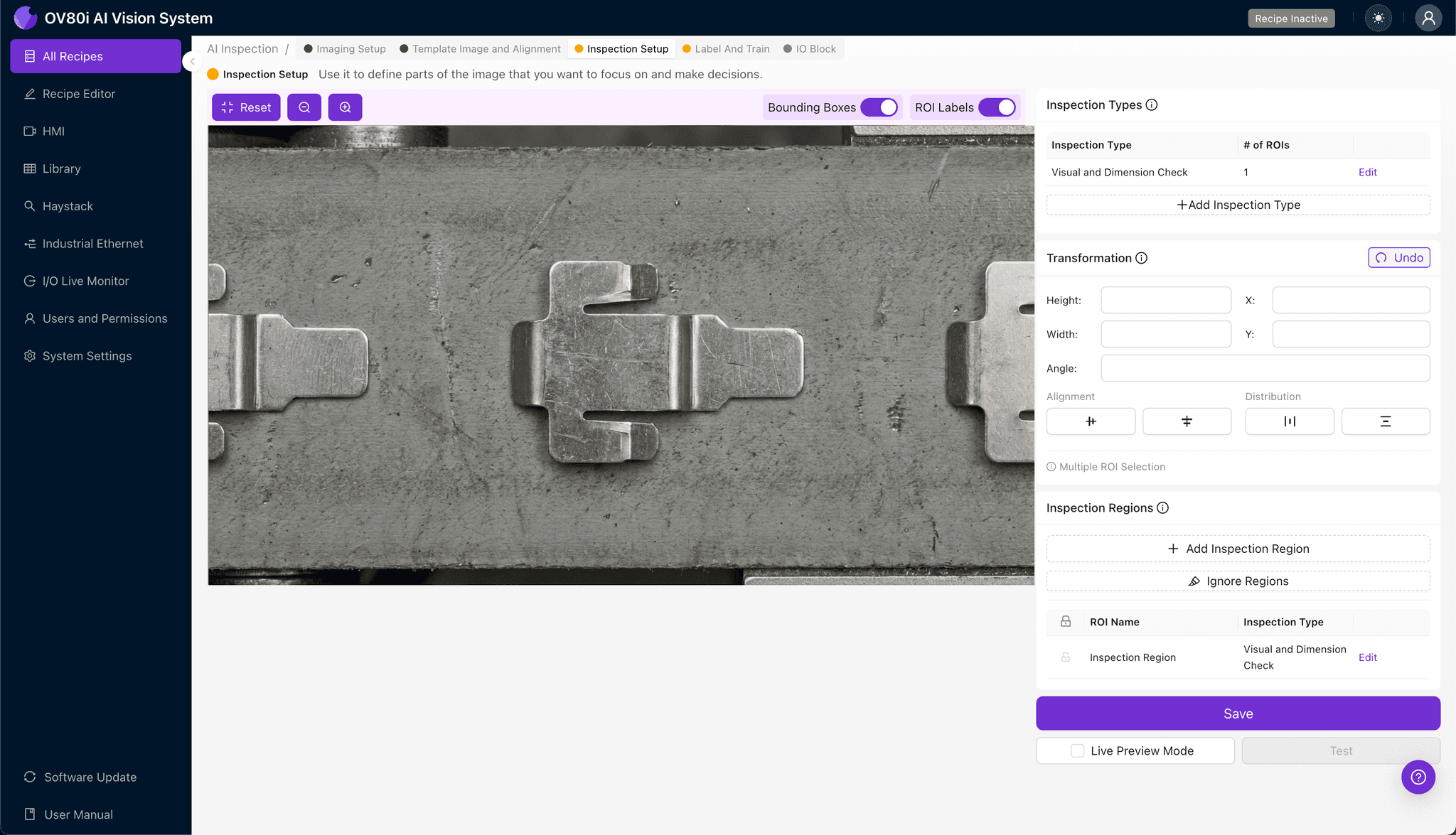
With your trained model ready, set pass/fail logic based on your defined Inspection Types. Configure confidence thresholds that balance escape rate against false rejection costs.
Gate automated acceptance directly on the production line. Parts meeting all inspection criteria proceed automatically, while suspect contacts are diverted for secondary review or rejection.
Key Outcomes & ROI
Implementing automated visual inspection for formed contact spring-back deviation delivers measurable business impact:
- Reduced scrap rates — catch deviation trends early and adjust forming parameters before producing large reject batches
- Higher throughput — eliminate inspection bottlenecks with 100% inline evaluation at full production speed
- Compliance and traceability — maintain complete inspection records for automotive, aerospace, and medical device quality requirements
- Process improvement insights — analyze defect patterns to identify tooling wear, material lot variations, and forming parameter drift
Conclusion
Elastic spring-back deviation in formed contacts demands inspection precision that human operators simply cannot sustain. Overview.ai's deep learning platform transforms this challenging quality control problem into a solved process—delivering consistent, objective evaluation of every part at production speed.
Ready to eliminate spring-back escapes from your contact forming line? Contact Overview.ai to schedule a feasibility assessment with your actual parts.
Eliminate Spring-Back Defects Today
Stop relying on manual inspection for formed contacts. Deploy Overview.ai to catch spring-back deviation instantly at full production speed.