Catalytic Converter Visual Inspection
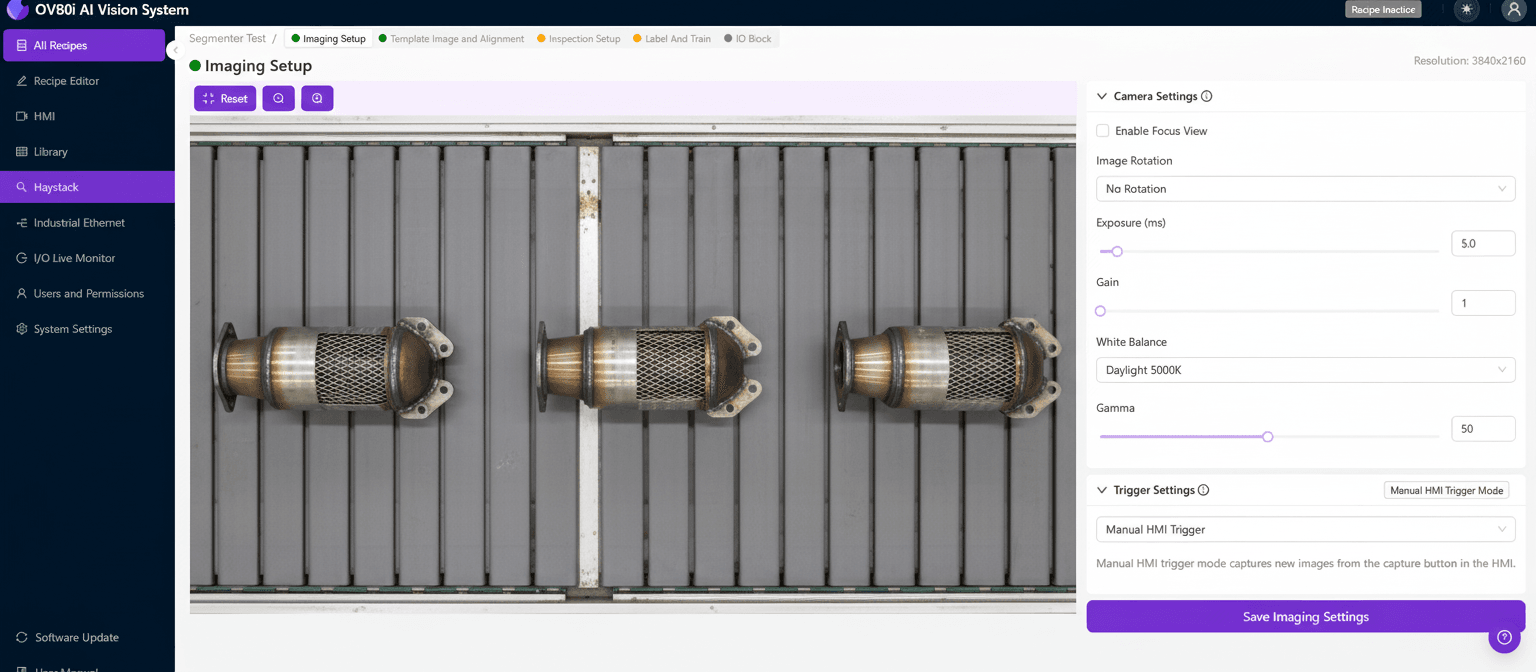
Catalytic converters fail in the field due to micro-cracks, blocked cells, poor canning, weld defects, contamination, and assembly mistakes that manual inspectors miss at line speed. AI-driven machine vision systems deliver 100% automated visual inspection, measuring critical features in 2D/3D, verifying assembly, and catching defects before they become costly emissions failures, warranty claims, or recalls.
The Problem: Traditional QC Can’t See Inside or Keep Up
Catalytic converters are multi-material assemblies with tight tolerances and complex internal geometry. A small defect in the substrate or a misaligned can can trigger Check Engine codes (P0420/P0430), rattling, sulfur smells, poor fuel economy, or smog test failures months after shipment. Most of these failure modes begin as visual and geometric anomalies that manual inspection routinely misses.
Where manual QC breaks down:
- Internal complexity: The ceramic/metallic honeycomb has hundreds of tiny cells. Chips, cracks, and partial blockages are hard to see, especially after washcoat application and canning.
- Subtle but critical variation: Weld porosity, undercut, spatter, and bead height variation can loosen joints or introduce leaks. Mat wrap overlap or gap outside spec causes brick movement and rattles.
- Speed and consistency: Line rates and SKU mix overwhelm human inspectors. Fatigue and subjective judgment produce high false accept rates.
- Hazardous, hot parts: Immediate post-weld and post-cure inspection is risky and time-limited, reducing thoroughness.
- Hidden contamination: Oil, coolant, silicone, or foreign particles degrade catalytic activity and emissions performance but often present as low-contrast visual changes.
- Traceability gaps: Misread or missing serials, barcodes, or laser etchings break the data chain needed for emissions compliance and root-cause analysis.
The outcome: defects escape to customers, leading to warranty replacements, brand damage, and regulatory risk. Symptoms seen in the field—reduced performance, dark exhaust smoke, misfires/stalling, rattling—are costly signals of upstream inspection gaps.
The Solution: AI Vision for End-to-End Converter Inspection
An integrated vision inspection system combines calibrated optics, illumination, 2D/3D sensing, and ai computer vision models to perform automated visual inspection at every critical stage—from substrate receipt to final pack-out. This replaces subjective checks with repeatable, measurable inspection and closed-loop feedback to your MES/PLC.
What AI vision detects and measures:
- Substrate and honeycomb integrity (pre- and post-washcoat)
- Broken cell walls, chips, missing corners, micro-cracks, and partial blockages
- Cell openness and uniformity using line-scan with backlighting
- Brick geometry: diameter, ovality, squareness, chamfer presence
- Washcoat condition
- Surface uniformity, runs/sags, discoloration, and contamination detection via intensity/texture analysis and multispectral options
- Mat wrap and brick fit
- Wrap width, overlap, seams, and gaps; misplacement relative to flow direction
- Brick-to-can interference fit measurement to prevent movement/rattle
- Canning, seams, and weld quality
- Seam continuity, undercut, porosity, spatter, over/under-penetration
- Bead height/width with 3D laser triangulation; heat tint/HAZ consistency
- End-cap and shell alignment; flange squareness and flatness
- Oxygen sensor bungs, tubes, and fittings
- Presence/absence, orientation, clocking; spatter or debris around threads
- Cap/plug presence and gasket seating; leak-risk indicators
- Heat shields, brackets, and fasteners
- Assembly verification: correct part, position, torque-mark presence, clip seating
- Foreign object detection (FOD) prior to heat shield closure
- Surface and handling defects
- Dents, scratches, dings, and deformation from conveyance or rework
- Markings and traceability
- OCR/OCV for laser etch, 1D/2D codes, paint marks; label quality and placement
- Direct serialization and lot linkage to the MES for full genealogy
How it works in production:
- Sensing and optics
- 2D area and line-scan cameras with telecentric lenses and controlled backlights for cell inspection
- 3D laser triangulation or structured light for weld bead metrology and flange flatness
- Coaxial, dome, and dark-field lighting to surface defects that are otherwise low contrast
- AI models tuned for manufacturing variability
- Supervised classifiers for known defects and anomaly detection for unknowns
- Part-independent feature extraction for SKU changes without full reteaching
- Domain adaptation to handle washcoat color shifts, alloy sheen, and lighting drift
- System integration
- PLC handshakes for pass/fail gates and reject mechanisms
- Automated recipe management by SKU; remote health monitoring
- SPC dashboards, feature trending, and alarms for process drift (e.g., weld bead height trending low)
- Performance at line speed
- Sub-1-second cycle times per station with parallelized cameras
- Detection resolution down to 50–100 µm on cell walls, depending on optics
- Tunable false positive/negative balance for your yield-risk profile
Beyond detection, the system closes the loop:
- Flags upstream process issues (e.g., mat wrap station out of spec, weld parameter drift)
- Provides actionable analytics (feature Cp/Cpk, top defect Pareto, tool wear indicators)
- Ensures regulatory readiness with complete digital records per unit
Key Applications & Outcomes
Where to deploy automated visual inspection on catalytic converter lines:
- Incoming substrate inspection
- Cell openness, chips/cracks, geometry validation; serialization capture
- Post-washcoat check
- Surface uniformity and contamination; orientation/flow-direction verification
- Mat wrap station
- Width, overlap, gaps, brick centering, and adhesive presence
- Canning and welding
- Shell alignment, seam integrity, weld bead metrology, spatter control
- Final assembly verification
- Bungs/fittings orientation, heat shields, brackets, fasteners, torque marks, caps/plugs
- Marking and traceability
- OCR/OCV on laser etch and labels; barcode grading; MES linkage
- Pre-pack QA
- Surface damage, dent detection, label presence and placement, FOD
Business outcomes for operations and quality leaders:
- Higher first-pass yield
- Catch and correct process drift before it creates scrap; reduce rework loops
- Fewer escapes and warranty claims
- Prevent field failures that trigger P0420/P0430 codes, rattling, or emissions test failures
- Faster, safer inspection
- 100% coverage at line speed without exposing operators to hot parts or weld cells
- Lower cost of quality
- Reduce manual inspection labor and variability; focus skilled technicians on root-cause work
- Stronger compliance and brand protection
- Digital traceability for every unit; audit-ready data; consistent label and code quality
- Scalable across SKUs
- Recipe-driven changeovers; ai computer vision models resilient to normal material and color variation
Why now:
- Emissions and regulatory pressure continues to rise while converter designs grow more complex (multi-brick assemblies, tighter tolerances).
- Mixed-model lines demand inspection that adapts instantly and never fatigues.
- Modern machine vision systems combine robust optics with learning-based defect detection to deliver measurable quality improvements without slowing throughput.
If you’re building or upgrading a catalytic converter line, an integrated vision inspection system is no longer optional. It’s the only reliable way to achieve 100% inspection, bulletproof assembly verification, and traceable quality—before your customer does it for you in the field.
See It in Action
Explore the OV80i and ask us about advanced inspection packages for your specific application.